
At a glance
- Work from soil volume, not the outer footprint - wall thickness, rim height and drainage layer all reduce the soil a planter actually holds.
- Nominal volume is simple geometry: internal length x width x depth gives litres for boxes; pi x radius squared x depth gives litres for cylinders.
- Annual bedding copes with the least soil; most shrubs want roughly 45 cm of depth or more.
- Deduct for a drainage layer and settling, and plan a top-up after the first season.
- Soil is heavy: roughly a tonne per cubic metre when wet, so large planters need a ground or deck check.
Why does soil volume matter more than planter size?
Three reasons, and all of them are about the soil mass, not the shell. Water buffer: a small soil volume dries out within hours on a warm, windy plaza, while a larger mass evens out the peaks - the same plant that sails through July in a 200 litre planter can collapse in a 30 litre one. Root room: roots need depth more than they need width, and shallow containers cap the species you can grow. Temperature: a bigger soil mass swings less; thin volumes in thin-walled metal planters heat and cool quickly, which stresses fine roots.
This is why two planters with the same footprint can behave completely differently. Height is the dimension buyers most often cut to save cost, and it is the one the planting list notices first.
How do you calculate the soil you need?
For a rectangular planter, multiply the internal length by the internal width by the internal depth, in metres, and multiply by 1,000 to get litres. A 40 x 40 x 40 cm interior holds 0.4 x 0.4 x 0.4 = 0.064 cubic metres, or about 64 litres. For a cylinder, use pi x radius squared x depth: a 30 cm diameter, 30 cm tall interior holds about 21 litres.
Then deduct. A drainage layer at the base takes a few centimetres, soil settles by a noticeable margin over the first season, and tapered or rounded interiors hold less than the bounding box suggests. Ordering soil to the nominal figure and topping up after the first season is the normal rhythm; our guide to preventing waterlogging in outdoor planters explains what the drainage layer is doing in exchange.
How much soil do different plants need?
Commonly cited horticultural guidance runs roughly like this: seasonal bedding and annuals cope with shallow volumes, around 20 to 30 cm of depth; most perennials and ornamental grasses want about 30 to 45 cm; most shrubs want 45 cm or more, both for the root run and for the water buffer; small trees and large specimens need the deepest volumes of all and are usually specified at street-tree scale. Exact numbers vary by species and climate, so treat these as sizing bands for the discussion with your landscaper, not as a planting standard.
The practical translation for procurement: check the planting list before fixing the planter height. A taller planter costs more once; replacing stressed planting every season costs more every year.
What do real LVEN planter sizes hold?
The table below takes the published dimensions of our planter range and converts them to nominal volume - the brimful geometric figure, before deductions. Use it to shortlist sizes, then subtract for drainage and settling as above.
| Model | Dimensions | Nominal volume | Typical use |
|---|---|---|---|
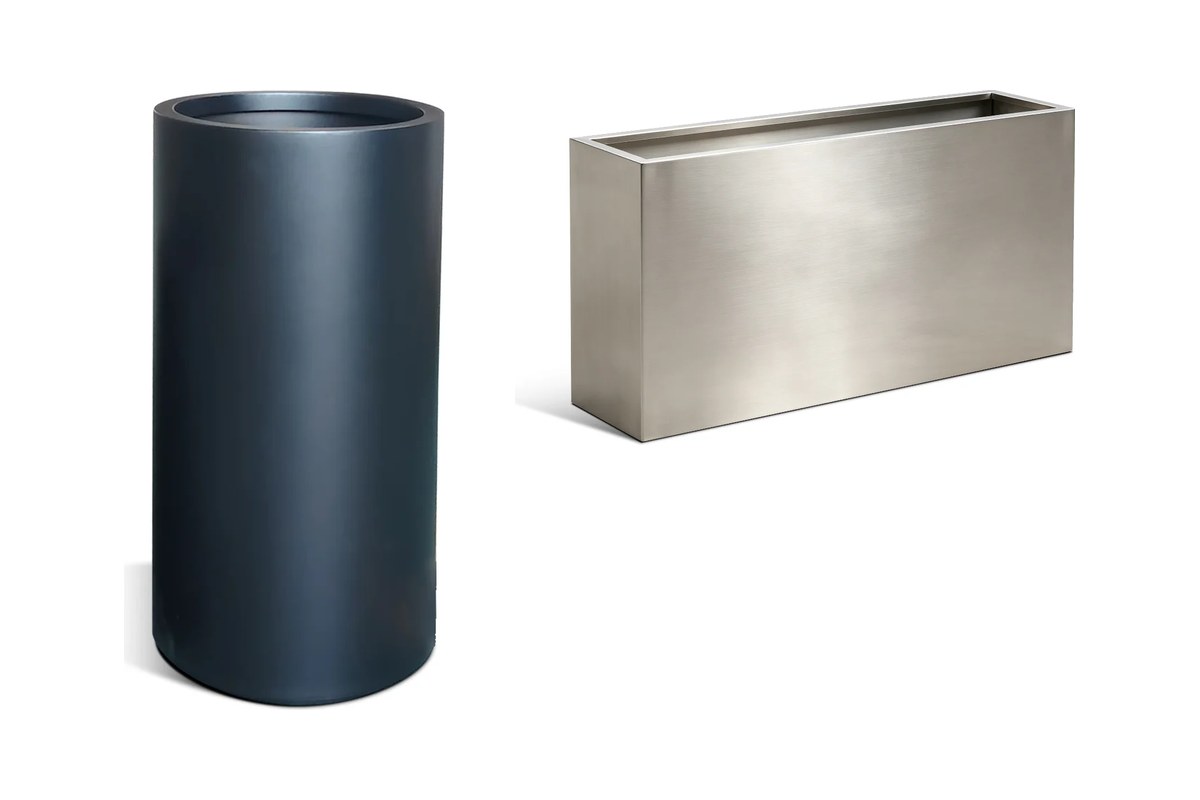
| OTHP-04 | D 30 x 30 cm | About 21 L | Accent planting, seasonal colour |
| OTHP-04 | D 35 x 50 cm / D 35 x 70 cm | About 48 L / 67 L | Entrance accents, small shrubs |
| OTHJ-01 | 28 x 28 x 60 cm | About 47 L | Vertical accents, grasses |
| OTHJ-01 | 42 x 42 x 100 cm | About 176 L | Tall statement planting |
| OTLB-04 | 120 x 30 x 60 cm | About 216 L | Linear screening and edges |
| OTLB-23 | 80 x 80 x 70 cm / 80 x 80 x 80 cm | About 448 L / 512 L | Semi-mature shrubs |
| OTLB-32 | D 60 x 80 cm / D 100 x 120 cm | About 226 L / 942 L | Feature and street-tree scale |
Two observations from the table. First, height does the heavy lifting: the 70 cm-tall cylinder in the OTHP-04 holds more than three times its 30 cm sibling from the same family. Second, large formats change the logistics - a planter near 500 litres of wet soil is a siteworks item, not a furniture delivery, and the ground below it should be prepared accordingly.
What else should you plan for?
Weight first. Wet soil runs at roughly a tonne per cubic metre, so a 500 litre planter carries about half a tonne before the plant, and rooftop or deck installations need that figure in the structural check. Material next: galvanized steel, stainless steel and aluminum all behave differently in weight and finish over time, and our planter material comparison sets out the trade-offs. Drainage has been covered above but is worth repeating as a checklist item with the sizing guide when planters double as space dividers.
Finally, plan the first-year service: a soil top-up, a check that drainage holes are still clear and an irrigation decision. Planters that survive their first summer rarely become maintenance problems afterwards.
If you are matching planter sizes to a planting list, send us the planting scheme and we will confirm dimensions, volumes and drainage details together. Completed installations are in our projects gallery.
Frequently asked questions
- How much soil do I need for a 40 cm planter?
A 40 cm cube holds about 64 litres at the brim, so order roughly 50 to 60 litres of soil once you allow for a drainage layer and settling. Cylindrical and tapered planters hold less than the cube calculation suggests, so measure the internal width and depth and use the volume formula before ordering soil by the bag or by the cubic metre.
- Should I put gravel in the bottom of a planter?
A thin drainage layer at the base can keep fine soil from washing into and blocking the drainage holes, but a deep gravel layer is usually counterproductive: it reduces the soil depth available to roots and creates a perched water line. What matters more is that the planter has real drainage holes and that water can leave the planter freely - our article on preventing waterlogging in outdoor planters covers the full drainage detail.
- How deep does soil need to be for shrubs?
Commonly cited horticultural guidance puts most shrubs at roughly 45 cm of soil depth or more, with perennials and grasses coping with less and seasonal bedding coping with the least. Exact needs vary by species and climate, so confirm the planting list with your landscaper before fixing the planter height - a taller planter is usually cheaper than replacing stressed planting every season.
Sizing planters for a planting scheme? Share the plant list and we will confirm volume, height and drainage together.