
At a glance
- Lid types trade three things against each other: weather protection, disposal speed and cleaning access.
- Open tops are the fastest to use and the simplest to empty, but they take in rain and let light litter blow out.
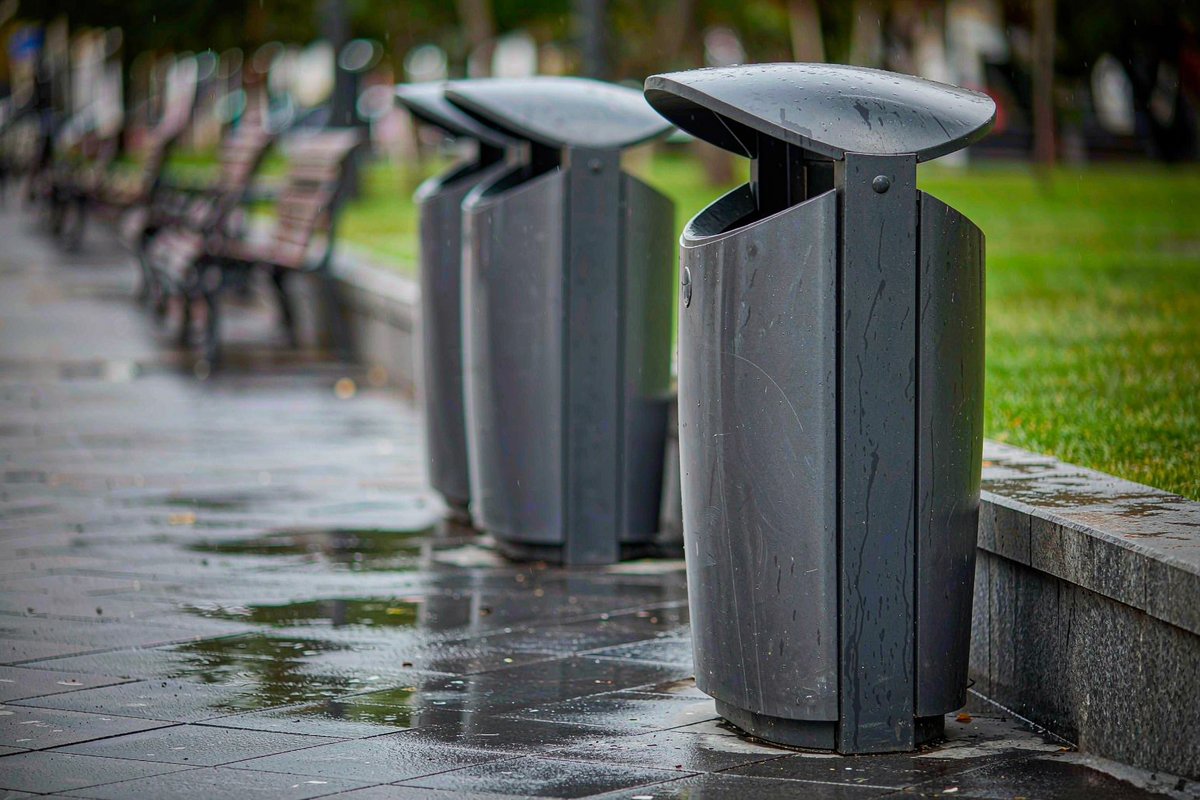
- Hooded and covered openings shield the waste entry while keeping it visible - a good default for exposed streetscapes.
- Flip-top lids close the bin fully and often double as the access hatch for the inner liner.
- Match the opening to the site's exposure, the waste stream and the emptying routine, not to the catalogue photo.
What does a lid actually do outdoors?
Four jobs, in order of how often they decide a specification. Rain: an open bin collects water, which adds weight to the liner, speeds up decomposition and odour, and eventually seeps out of seams and service doors. Wind: cups, wrappers and receipts blow out of an open top, which is why exposed promenades often show litter scattered around otherwise empty bins. Behaviour: a visible, generous opening invites correct use, while a hidden or awkward one pushes waste to the ground or on top of the lid.
There is also housekeeping. The cleaning crew lifts an inner liner out of every bin, so the opening has to give them a clear path. Whatever type you choose, check that the lid, the aperture and the removable liner work together - our guide to litter bin opening sizes covers that dimension separately.
When does an open top work best?
Where turnover is high and disposal is quick: transit platforms, food-court edges, plaza entrances, school corridors. Nobody waits at a bin, so anything that slows the gesture - a flap to push, a hood to aim into - shows up as litter beside the bin rather than inside it. An open top also makes fill level obvious at a glance, which helps collection crews judge their route.
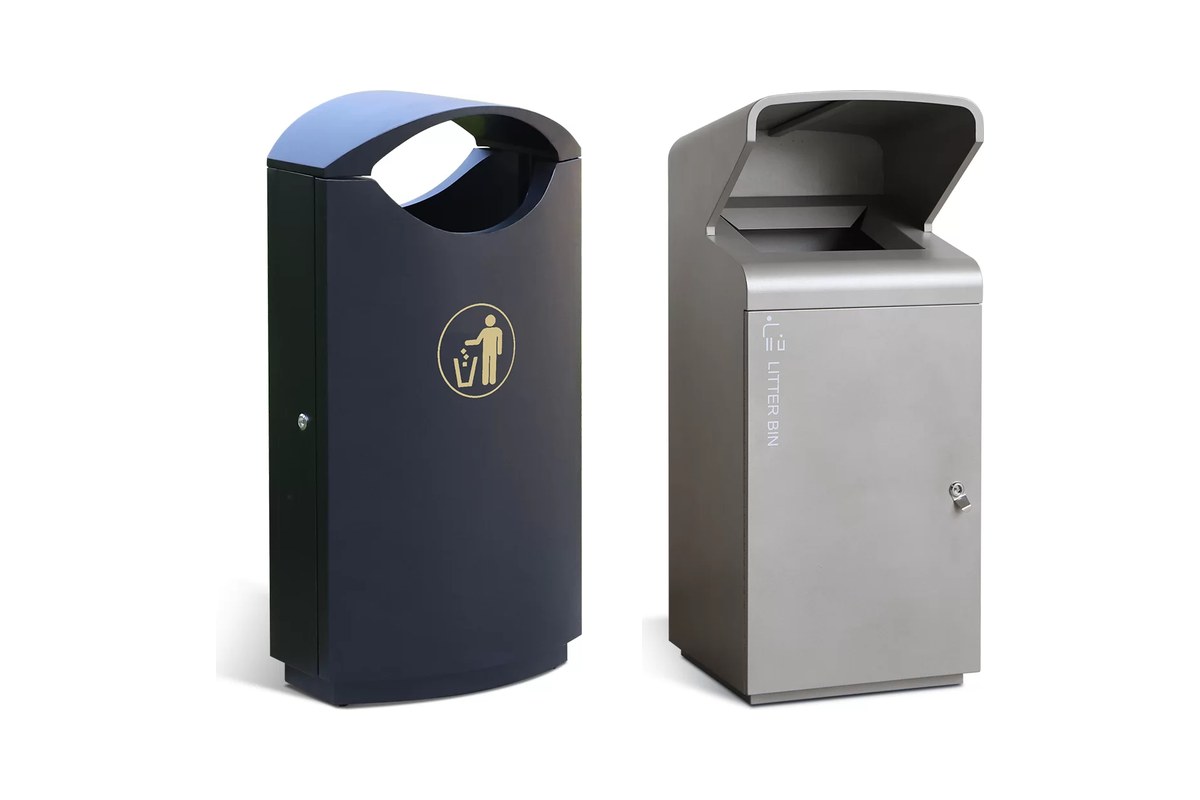
The OTB-14 is a typical example: a 60 L steel bin, 50 x 33 x 98 cm, with a curved open-top design that keeps the entry clear and unobstructed. In covered arcades, under canopies and in mild dry climates, an open top is a completely reasonable choice. The weakness appears where bins stand in the open: rain goes straight in, and in autumn the aperture fills with leaves faster than with litter.
Why choose a hooded or covered opening?
A hood is a fixed canopy over the entry. It sheds rain sideways rather than letting it fall in, keeps light litter from blowing straight through, and does all this without a moving part - nothing to jam, nothing to replace. The entry stays visible, so users still aim confidently and crews still see the fill level.
The OTB-84 uses this layout: a 90 L heavy-duty body, 45 x 45 x 107.6 cm, with a hooded top opening, a lockable front service door and a removable metal inner liner. The OTB-422 takes a similar covered top opening on an 80 L modular body, 48 x 35 x 95 cm, that can be installed alone or paired into a two-stream sorting point. For exposed streetscapes, waterfront paths and transit stops, a hooded or covered opening is usually the most balanced default.
What does a flip-top lid add?
A flip-top closes the bin completely. That keeps rain out of the liner, holds odour down between collections, and hides the contents - which matters at building entrances and anywhere appearance is inspected daily. On the OTB-28, a 50 L round bin, 48 cm diameter and 88 cm high, the flip-top lid also serves as the access hatch when the crew lifts the inner liner out.
The costs are real, though. Disposal is slower because the user must move the lid, and a percentage of people will not, so a flip-top bin needs a more generous aperture or a more visible position to collect the same waste. The hinge and its fixings become the maintenance item to check during routine inspections.
How do lids interact with sorting and fire safety?
Multi-compartment bins need one opening per stream, and the opening type must be consistent across the unit or one stream ends up ignored. The OTB-30 (three 40 L compartments) and the OTB-45W (30 L and 50 L compartments) pair covered openings with lockable doors and removable liners, so each stream is protected from rain while the whole unit empties from the front.
Fire deserves a separate sentence. A hooded or covered opening does make it harder to drop something smouldering straight onto the waste, and that is worth having - but no public litter bin is fireproof, and hot ash belongs in a dedicated ash column such as those in our ashtray range, not in a general waste bin. Our article on preventing litter bin fires covers siting and material choices in detail.
| Model | Opening type | Capacity | Dimensions | Suits |
|---|---|---|---|---|
| OTB-14 | Curved open top | 60 L | 50 x 33 x 98 cm | High-turnover, covered or sheltered locations |
| OTB-84 | Hooded top | 90 L | 45 x 45 x 107.6 cm | Exposed promenades, roadside and commercial zones |
| OTB-422 | Covered top, modular | 80 L per unit | 48 x 35 x 95 cm | Streets, waterfront paths, paired sorting points |
| OTB-28 | Flip-top lid | 50 L | D 48 x 88 cm | Entrances and areas where appearance is checked daily |
Whichever type you pick, walk the site in the rain once before ordering. Where the water goes, where the wind funnels and how far the nearest shelter is will settle the lid question faster than any catalogue comparison. The full litter bin range lists all models with their opening types and dimensions.
If you are matching openings to a specific site or waste stream, send us the location details and we will confirm the specification before quotation. Completed installations are collected in our projects gallery.
Frequently asked questions
- Do outdoor litter bins need lids?
Not always. A lid protects the waste entry from rain, keeps wind-blown litter inside and slows odour, but it also slows disposal down. Open tops suit high-turnover, covered or sheltered locations; hooded or flip-top openings suit exposed streetscapes and waterfronts. Match the opening to the weather exposure and the cleaning routine rather than choosing one type for every site.
- What is a hooded litter bin?
A hooded litter bin has a curved canopy over the waste entry. The hood shields the opening from falling rain and reduces wind-blown litter escaping or entering, while keeping the entry visible and reachable without a moving part. Models like the LVEN OTB-84 (90 L) use a hooded top opening for exposed public areas such as beachfront promenades and roadside zones.
- Which bin opening keeps rain out most effectively?
A fully closed flip-top lid keeps rain out most effectively, followed by a hooded or covered opening, with a fully open top taking in the most water. The trade-off is disposal speed: a flip-top must be lifted or pushed, which some users avoid. In very exposed locations, a covered opening combined with a removable inner liner usually gives the most practical balance.
Choosing openings for a whole site? Send us the site plan and we will match bin models, openings and capacities to each zone.