
At a glance
- UV protection in HDPE lives inside the board: stabilisers and pigments blended during extrusion, not a coating
- Through-coloured boards hide scratches and wear; saturated dark colours show fading sooner
- Pair HDPE slats with powder-coated steel frames so each material handles what it does best
- Ask how the board is stabilised and what exposure testing the formulation has passed, not just for "UV resistant"
What does UV actually do to HDPE and composite boards?
Ultraviolet radiation carries enough energy to break the polymer chains in plastic. Over time this photo-oxidation shows up in a predictable sequence: loss of surface gloss, then chalking as degraded polymer powders away, then colour shift as pigments near the surface are lost, and finally embrittlement that can crack a board under load. Rain and heat accelerate the cycle; a wet board in strong sun degrades faster than a dry one.
The key point for buyers is that this process starts at the surface and works inward. That is why a board that is already chalked can often be sanded back to sound material, and why slats on a bench usually fade on their upper face first. It is also why surface-applied "UV coatings" on cheap plastic lumber achieve little: the coating wears, and the unstabilised core underneath is exposed. Real protection must be distributed through the whole cross-section.
Wood-plastic composites sit somewhere between: the wood fibre component can grey from sunlight just as natural timber does, so quality composite boards also carry UV stabilisers and colour pigments designed to weather evenly rather than patchily.
How is UV resistance built into HDPE furniture?
Three ingredients do the work, all blended into the polymer before the board is extruded. UV absorbers convert harmful radiation into harmless heat before it reaches the polymer chains. Hindered amine light stabilisers (HALS) interrupt the chemical degradation chain reaction once it starts. And the pigment system itself, especially carbon black and high-quality titanium-dioxide-based colours, blocks radiation from penetrating deep into the board.
This is why through-colour matters so much in public furniture. A board coloured all the way through can be scratched, sanded or edge-cut without exposing a different core colour, and minor wear simply disappears into the surface. It also means a well-formulated board never depends on a factory-applied finish that a maintenance crew would have to renew.
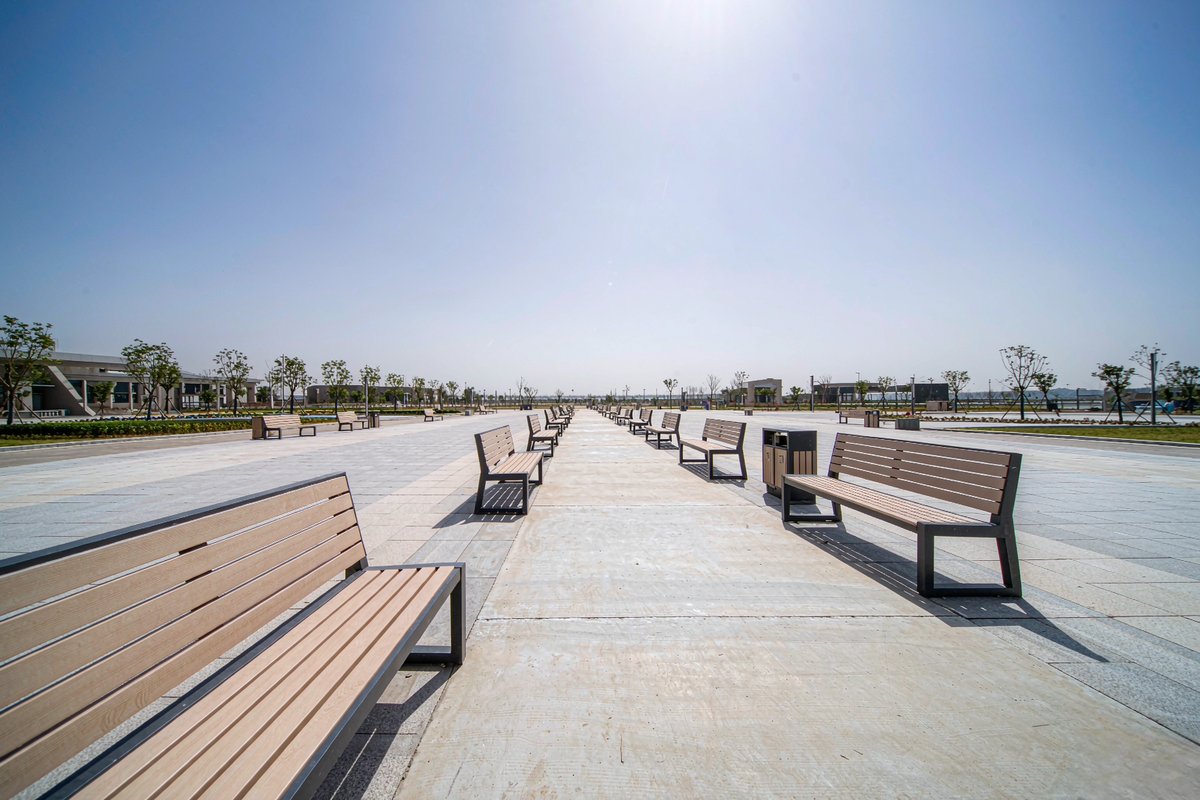
The frame matters just as much. Most HDPE-slat benches and picnic tables pair the plastic slats with a powder-coated steel structure, which handles rigidity and load while the HDPE handles sun and moisture. Coating choice for that steel frame is a separate specification question we covered in powder coating vs fluorocarbon coating.
HDPE, hardwood and powder-coated steel under full sun
No single material wins every exposure, so the comparison below is how we frame the choice for clients specifying full-sun sites:
| Aspect | HDPE / composite slats | Hardwood slats | Powder-coated steel |
|---|---|---|---|
| UV response | Stabilised boards resist chalking and fading; colour holds for years | Surfaces grey and check unless oiled; structure unaffected | Quality coatings resist chalking; chips need touch-up |
| Maintenance | Wash only; no sealing or repainting | Periodic oiling or sealing in exposed sites | Inspect for chips, touch up cut edges |
| Heat behaviour | Surface gets hot in direct sun; thermal expansion gaps required | Stays cooler; low movement | Frame gets hot but does not deform |
| Best role | Seat and back slats in full sun | Premium look in sheltered or managed sites | Frame, legs and structure everywhere |
A useful way to read this table: HDPE is the low-maintenance choice for slats that sit in the sun all day, hardwood is the premium choice where a maintenance programme exists, and steel belongs in the structure where its UV exposure is mainly a coating problem. Our wood vs composite vs aluminium slat comparison adds the structural side of that decision.
Which colours and finishes cope best with strong sunlight?
Colour choice has a real effect on how a bench ages. Carbon-black-based and earth-tone pigments are the most lightfast, so grey, brown and charcoal boards keep their appearance longest. Bright saturated colours and pale tones show fading and surface chalking sooner, simply because the eye notices the shift. Lighter colours also run cooler to the touch, which matters for benches in direct midday sun where seat temperature affects usability.
Texture is worth specifying too. Wood-grain embossed boards disguise minor surface wear far better than high-gloss finishes, and a matte or satin surface hides the early micro-scratches that gloss surfaces turn into visible haze.
How should you verify UV performance before ordering?
"UV resistant" on its own is not a specification. When comparing suppliers, ask three concrete questions. First, is the board through-coloured with stabilisers in the full cross-section, or is there a cap or coating layer doing the work? Second, what exposure testing has the formulation passed, and can the supplier describe it in plain terms such as accelerated weathering hours? Third, how does the supplier handle colour consistency across production batches, since a replacement slat ordered two years later should still sit visually close to the originals?
A manufacturer that produces its own boards or slats, rather than buying whatever is cheapest on the market that month, can usually answer all three without hesitating. LVEN has produced outdoor furniture across three bases since 2012 with more than 410 patents in the range, and treats board formulation and fixing details as part of the product rather than an afterthought; the projects on our projects page show these material choices in built environments.
If you are furnishing a hot-climate or high-exposure site, send us the location, the sun exposure and the maintenance budget, and we will recommend the slat material and colour mix that ages best; request a specification quote here.
Frequently asked questions
- Does HDPE furniture fade in the sun?
- UV-stabilised HDPE fades far more slowly than unstabilised plastic, but no polymer is fully immune. Through-coloured boards with UV stabilisers and high-quality pigments keep their appearance for years in full sun, while cheap unstabilised board can chalk and lose gloss within one or two hot seasons.
- Is HDPE better than wood for outdoor furniture in hot climates?
- For full-sun sites with low maintenance budgets, HDPE and wood-plastic composite slats are usually the safer choice: they need no oiling or sealing, resist rot and insects, and handle heat and rain cycles without cracking. Hardwood such as Merbau still wins on premium feel and rigidity, but demands a regular maintenance programme.
- How long does HDPE outdoor furniture last in full sun?
- Service life depends on the UV package in the board, the pigment quality and the local climate, so there is no single figure. Well-formulated stabilised HDPE is specified for long public-service lives precisely because it needs no repainting or sealing; the frame, usually powder-coated steel, then becomes the part to inspect.
Specifying for a full-sun site? Send us the location and usage level for a material recommendation.
Get a quote