
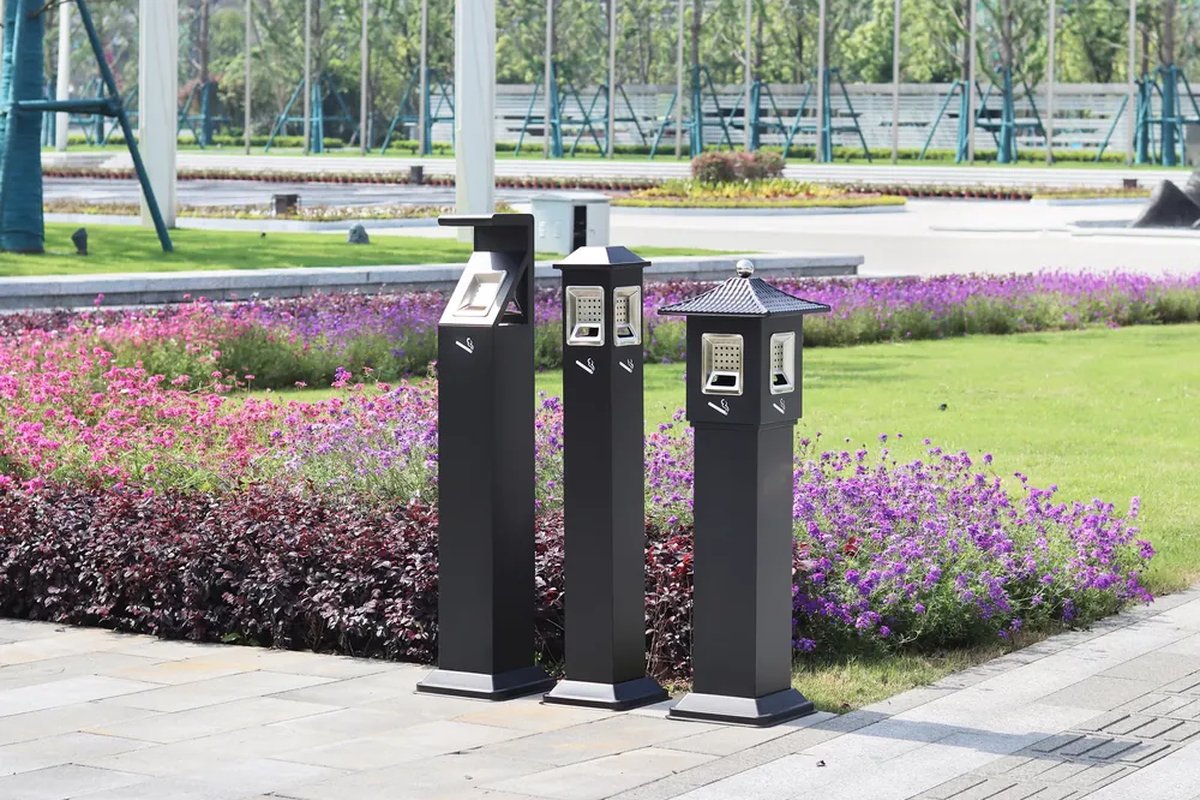
At a glance
- Site ash columns where smokers already stop: doorways, seating clusters and waiting fronts — not in the middle of open paving.
- An ashtray opening around 1.0–1.2 m above the pavement is comfortable hand height, sheds rain and hides the contents from view.
- Pair every ash column cluster with an outdoor litter bin so general waste never ends up in the ashtray.
- Galvanised steel with outdoor powder coating or 304 stainless steel, with a removable inner liner and lockable service door, stands up to weather and daily emptying.
Why does cigarette litter appear even when bins are nearby?
Because a litter bin and a cigarette end are two different problems. A smoker arriving at a building usually extinguishes the cigarette at the moment they stop — at the door, at the edge of the shelter, at the bench where they wait. If the nearest thing at that spot is a wall-mounted bin five steps away, or a bin opening designed for cups and wrappers, the end tends to land underfoot. Ash columns succeed because they intercept the behaviour instead of fighting it: a dedicated unit at the standing point gives the smoker a natural target at hand height, and the small opening signals "ends only" far more clearly than a wide bin mouth does. For specifiers, ash columns are a siting decision first and a product decision second — and outdoor litter bins should never be expected to double as ashtrays, because ends wedged in general waste are a fire risk during emptying.
How many ash columns does a smoking zone actually need?
Count dwell points, not square metres. In practice this gives three rules of thumb. First, every entrance or exit where people pause to finish a cigarette before going inside justifies one column within two to three metres of the doorway, offset clear of the door swing. Second, in a designated smoking area with seating, each seating cluster — not each bench — gets one column, grouped with the litter bin so both are emptied on the same round. Third, along long waiting fronts such as transit shelters, columns are spaced so a smoker is never more than a short walk from one.
Two habits separate tidy installations from messy ones. Grouping columns in twos or threes at the busiest dwell points concentrates the emptying route instead of sending cleaning staff across the whole site for single units. And resisting the urge to oversupply matters: a field of scattered ash columns reads as clutter and gets ignored. Where a site also has picnic or seating zones, the same logic extends to the wider furniture plan described in our project references.
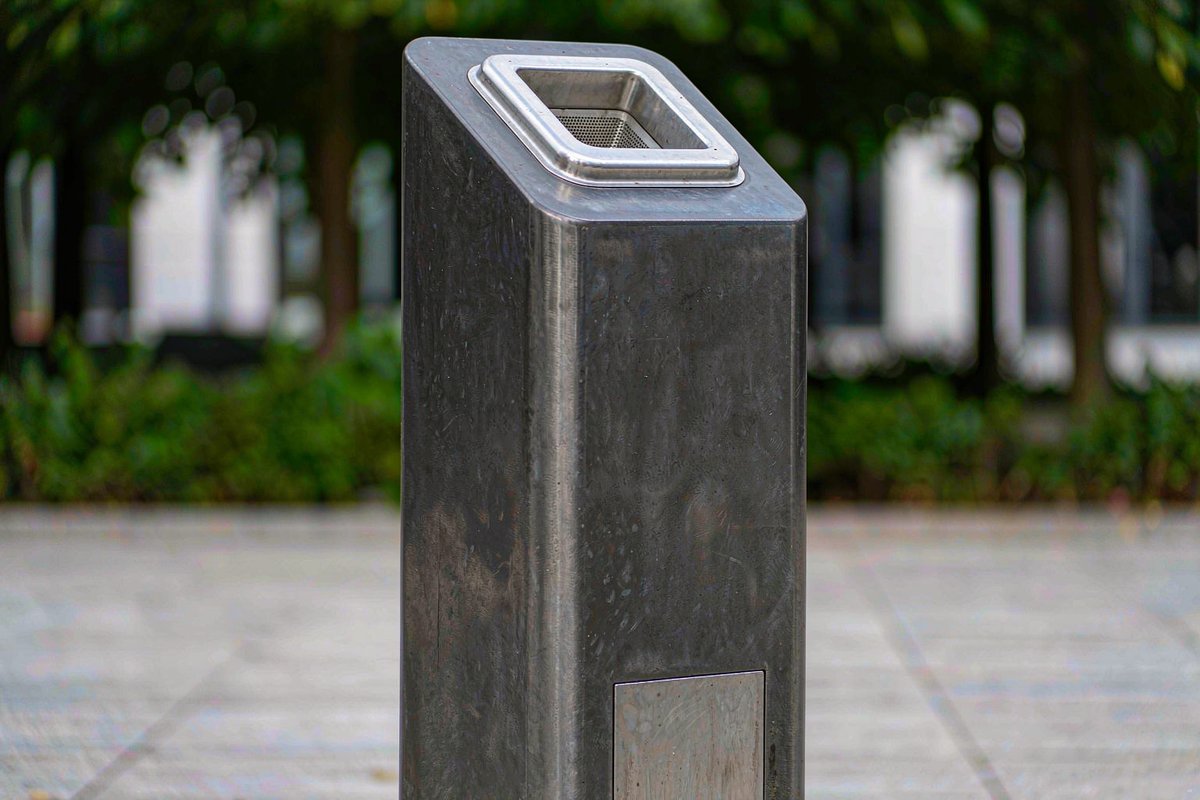
Which height, material and liner should you specify?
Once the siting is settled, the hardware choices repeat from site to site. The table below summarises the specification focus for the three most common settings:
| Setting | Siting rule | Specification focus |
|---|---|---|
| Entrances and exit doors | One column within 2–3 m of each doorway, clear of the door swing | Hooded or angled top to shed rain; anchored base so the unit cannot be tipped |
| Designated smoking areas | One per seating cluster, grouped with a litter bin | Eye-level opening; removable inner liner sized to the daily emptying round |
| Transit and waiting areas | Spaced along the waiting front, always a few steps from any point | Vandal-resistant lockable service door; finish matched to other street furniture |
On materials, the same two workhorses cover most sites. Galvanised steel finished with an outdoor powder coating is the default for parks, plazas and campuses: the zinc layer protects scratches from spreading into rust, and the coating carries colour so the column matches bins and benches in the same family. Where a coastal location or a premium plaza demands it, 304 stainless steel is the upgrade path — the reasoning is the same as for bins, which we compared in detail in stainless steel vs powder-coated steel litter bins. Whichever body is chosen, the details that decide daily satisfaction are the removable inner liner, a lockable service door, and a hood that keeps rain out.
Where should ash columns never be placed?
Three placements cause the most regret. Directly beside an air intake, a canopy pocket or a covered doorway where smoke lingers — the column solves the litter problem but moves the complaint to the smoke. On an accessible route or across a desire line, where the unit becomes an obstruction rather than an amenity; keep the standing point off the clear walking corridor. And in remote corners "for completeness" — an isolated column with no natural footfall collects everything except cigarette ends. If a site review finds a corner already used as an impromptu ashtray, that is exactly where a column belongs.
Emptying frequency closes the loop. A liner that overflows teaches users to pile ends on the lid or the ground, and the hotspot returns. Matching liner size and service round to the busiest dwell point is the unglamorous half of the specification. If you are unsure what that means for your site, send us the layout and the estimated footfall and we will suggest a siting plan and unit count before anything is manufactured.
Specifying ash columns with LVEN
Hunan Lven Urban Furniture Co., Ltd. has manufactured urban public furniture since 2012 across three production bases in Changsha, Jinhua and Foshan, totalling more than 20,000 m², with over 410 patents and delivery to projects in more than 60 countries. Our ash column range covers hooded and flat-top models in powder-coated steel and stainless steel, with removable liners, lockable service doors and surface-mount or in-ground fixing options.
If you are drawing up a smoking-area plan and want the siting, materials and emptying logic checked against your site, contact our team with the scene description. We will return a proposal with unit counts and finishes before production begins.
Frequently asked questions
- How many ash columns should a smoking area have?
- Place one at every point where smokers naturally stop and stand — each entrance or exit, each seating cluster in a designated smoking area, and at regular intervals along waiting fronts such as transit stops. Grouping columns in twos or threes beside a litter bin is easier to empty than scattering single units across the site.
- What height should an outdoor ash column be?
- Most designs put the ashtray opening at roughly 1.0–1.2 m above the pavement, which is comfortable hand height for a standing adult. A hooded or angled top at this height sheds rain, hides the contents from view and keeps the opening out of reach of small children.
- Do smoking zones still need litter bins if there are ash columns?
- Yes. Ash columns only collect cigarette ends and a small amount of ash; wrappers, bottles and food packaging still need somewhere to go. Pairing every ash column cluster with an outdoor litter bin is what stops general waste being stuffed into the ashtray opening.
Need this specified for your own site? Send us the scene, quantity and finish requirements.
Get a quote