
At a glance
- Loose components go first: seat slats, bin lids, access doors and anything held by standard fasteners.
- Security bolts - pin-hex, pin-torx, shear nuts - cost little at fabrication and are impractical to retrofit.
- Anchoring matters as much as bolt type: base plates with expansion or chemical anchors set into concrete.
- The strongest anti-theft feature is design: welded frames, hidden fixings and one-piece bodies leave nothing worth stealing.
Which parts get stolen or vandalised first?
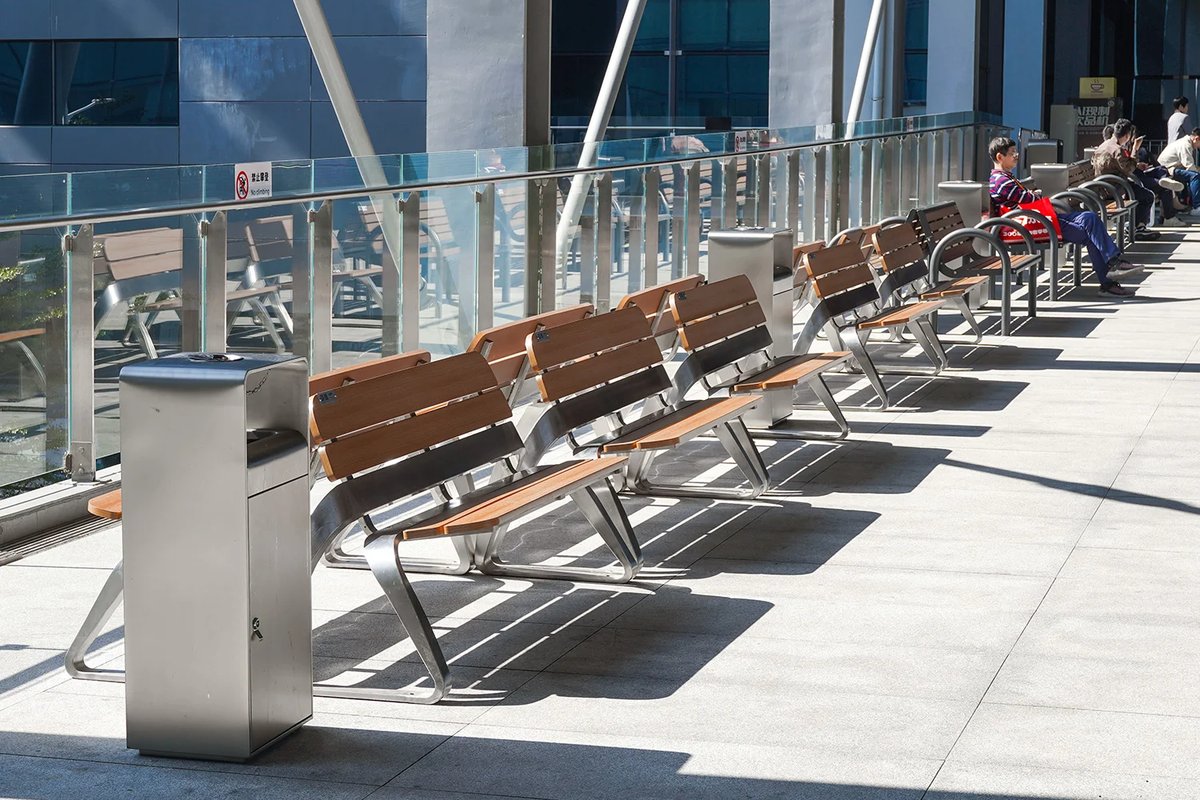
The pattern is consistent across public furniture: theft follows value per gram and ease of removal. Hardwood slats come off benches because they stack, burn or resell; bin lids and access doors disappear because they are light and standard; entire lightweight bins on thin pedestals get lifted where anchoring is shallow. Vandalism, meanwhile, targets visible fasteners - a standard hex bolt takes seconds to loosen with a common spanner.
That is why a serious specification treats the bin body and the bench frame as one security problem. Our ranges of park benches and outdoor litter bins are built around welded frames and lockable access doors, so the fixings only have to protect the parts that remain removable.
What types of anti-theft fixings are available?
Four families cover most needs. Hex-socket bolts are the everyday workhorse: cheap, strong and only slightly better than a plain bolt, but acceptable where the part has little resale value. Pin-hex and pin-torx add a central pin so standard tools do not fit - the usual choice for slats and lids. Shear nuts snap off their hexagon at a set torque, leaving a cone nobody can grip. And the strongest option is not a fastener at all: welded or fully hidden fixings that need no tool to defeat because there is nothing to grip.
None of these stop a determined thief with an angle grinder. The goal is to make casual removal slow and noisy, because that is what actually happens in public space.
Which fixing suits which part?
The choice is a trade between security level, maintenance access and cost. Most public programmes mix families within one site.
| Fixing type | Where it suits | Trade-off |
|---|---|---|
| Hex-socket (allen) | Low-value parts: covers, trims | Fast to install; only mildly deters tampering |
| Pin-hex / pin-torx | Slats, lids, doors - the usual choice | Maintenance crews need matching security tools |
| Shear (break-away) nuts | Perimeter fixings, signage, thin posts | One-way: removal means cutting the bolt |
| Welded or hidden fixings | Frames, base plates, premium sites | Highest security; heavier fabrication cost |
How should furniture be anchored to the ground?
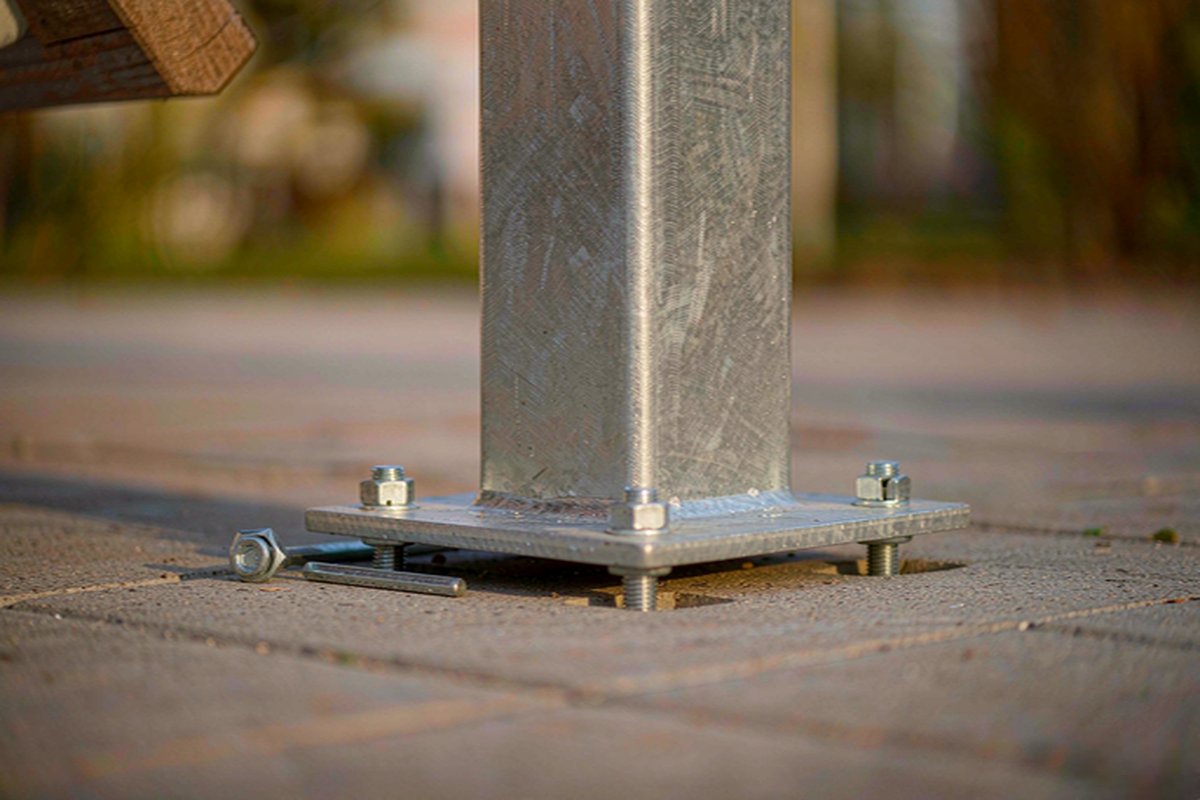
Bolt type is wasted if the anchor point is weak. On concrete paving or a poured pad, the standard detail is a steel base plate welded to the frame, fixed with expansion anchors - or chemical anchors where pull-out strength matters or the slab is thin. On soil or lawn, the furniture goes onto a concrete footing, either with pre-embedded bolts cast in or with post-installed anchors once the pad has cured.
Two practical notes from site. Torque-check all anchors a few weeks after installation: bedding-in loosens even correct fixings. And keep the fixing detail sheet with the as-built drawings - when a slat needs replacing years later, as our walkthrough of on-site slat replacement shows, the crew should know exactly which security tool opens which part. Anchor corrosion is the other silent risk; choosing finishes well is covered in our guide to preventing rust on outdoor steel furniture.
A pin-torx screw costs a fraction more than a standard bolt at fabrication. A stripped hardwood slat, a missing bin door or a tilted bench costs a maintenance visit, a part and weeks of degraded service. Across a whole estate or park programme, specifying security fixings and proper anchoring at order time is the cheapest line in the budget - and it is invisible when done well. If you are planning a scheme, send us the site conditions and furniture list and we will come back with fixing and anchoring details per model. Reference installations are gathered on the projects page.
Frequently asked questions
- What fixings stop people from stealing park bench slats?
- The common answer is pin-hex or pin-torx security screws, which need a matching tool with a central pin, combined with slats that sit in a machined or welded channel so they cannot be lifted even if a fastener is turned. Shear nuts are used where a permanently fixed head is acceptable.
- How do you anchor a public bench to concrete?
- A steel base plate is welded to the bench frame and fixed to the slab with expansion or chemical anchor bolts, torqued to the manufacturer's value and re-checked a few weeks after installation. On soil, the bench is set on a concrete footing with cast-in or post-installed anchors.
- Are anti-theft fixings worth the extra cost on outdoor bins?
- Usually yes. The upgrade at manufacture is a small fraction of the cost of replacing lids, doors or slats, and lockable access doors protect the liner and the collected waste as well. Maintenance crews need the matching security tools, so order them together and record which parts use which fixing.
Need this specified for your own site? Send us the scene, quantity and finish requirements.
Get a quote