
At a glance
- Specify by zone first: entrances, courtyards, playground edges and parking walkways each pull for different furniture.
- Galvanised steel with powder coating, hardwood or HDPE slats and stainless hardware form the proven outdoor baseline.
- Bins, benches and planters work as a system: shared fixing details and finishes cut maintenance for the property team.
- Buy on per-component specifications and spare-part availability, not on catalogue photography.
Which furniture does a residential community actually need?
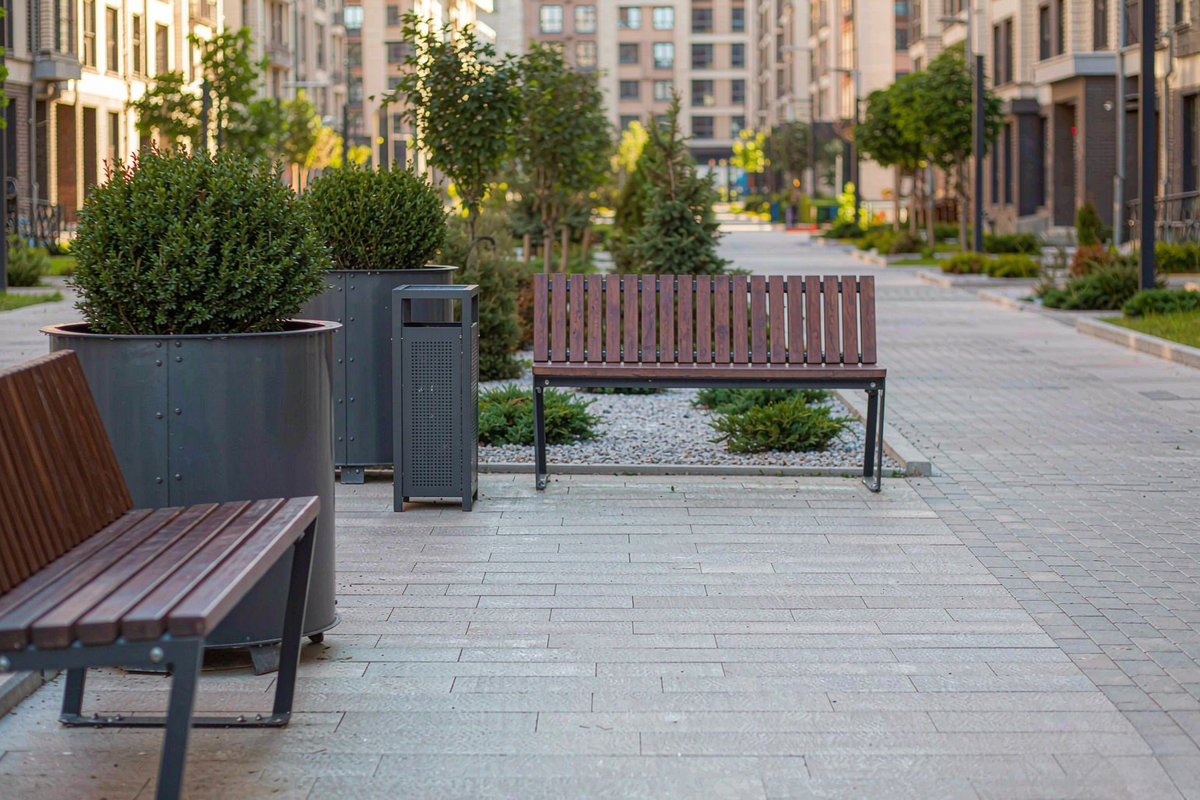
Walk any estate and the demand splits into four zones. Entrances and mail areas need litter bins and, in smoking spots, ash columns, because that is where people stand still with hands free. Courtyards and garden loops need seating at natural stopping points: shade, play areas, exercise corners. Playground edges need parent seating placed with a clear sightline to the equipment. And parking edges and internal roads need low, heavy planters that quietly organise movement without feeling like fencing.
Listing the zones before the products keeps the order realistic. A typical community scheme combines park benches and tree-seat variants for the garden loops, outdoor litter bins at entrance clusters and route mid-points, planters where planting, traffic calming and boundary definition are needed at once, and a small number of ash columns near designated smoking corners. How each element is proportioned for heavy public use is covered in our guide to choosing benches for high-traffic plazas.
Which materials hold up around homes?
Residential sites are gentler than city centres but run for decades on thin maintenance budgets, so the material baseline matters more than style. Galvanised steel frames with an outdoor powder coating resist corrosion and touch up easily. Hardwood slats - merbau, teak and similar dense species - can be re-sanded and re-oiled on site, while HDPE composite slats skip that maintenance entirely at the cost of a different ageing look. Stainless steel 304 earns its premium at entrances, bin bodies and coastal estates.
Whichever route you take, keep it consistent across the package. Mixed systems mean mixed spare parts, mixed touch-up paint and mixed cleaning instructions for the property team - the quiet cost that shows up in year three.
How should each element be specified?
The table below is the working checklist we use when a developer sends us a site plan.
| Element | Where it works best | Specification notes |
|---|---|---|
| Benches | Courtyards, garden loops, playground edges | Galvanised steel frame, hardwood or HDPE slats, seat height around 420-450 mm, security fixings |
| Litter bins | Entrances, and along the main walking route | Lockable access door, inner liner, opening matched to the waste streams residents actually sort |
| Planters | Parking edges, level changes, entrance definition | Steel body with drainage, root volume matched to shrub species, low and heavy where vehicles pass |
| Ash columns | Designated smoking corners near entrances | Self-extinguishing top, lockable, easy-empty inner chamber |
What should the quotation and handover include?
Three things separate a smooth handover from a support headache. First, fixing and anchoring details per model, so the landscaping contractor pours the right pads and the furniture is anchored from day one. Second, a spare-part package - a few spare slats, touch-up paint, a spare liner - stored on site. Third, written warranty terms per component, which are far easier to compare when they sit in the quotation rather than being promised later; our article on outdoor public furniture warranty explains what to expect.
Developers who share the site plan, climate and usage expectations get the most useful quotations back. You can send us the layout and requirements and we will return a per-zone specification with quantities, finishes and anchoring details. Completed residential and public schemes are collected on the projects page.
Frequently asked questions
- How many benches and bins should a residential community have?
- As a starting point, one litter bin cluster at every entrance area and roughly every 80 to 100 metres along the main walking loop, with benches wherever people naturally stop: shade, playground sightlines, exercise corners and mail areas. The right count depends on the site plan, so treat these figures as a first pass to check against the layout rather than a fixed standard.
- Which materials are most common for residential community outdoor furniture?
- Galvanised steel with powder coating for frames, hardwood or HDPE composite for slats, and stainless steel for bin bodies and entrance-area items. The choice usually comes down to climate, budget and how much maintenance the property team can realistically carry out each year.
- Should a developer buy benches, bins and planters from one supplier?
- A single package keeps finishes, fixing details and spare parts consistent, and gives the property team one contact when something needs repair. That said, compare quotations on equivalent specifications - frame material, coating system, slat material and fixings - rather than on catalogue photos alone.
Need this specified for your own site? Send us the scene, quantity and finish requirements.
Get a quote