
At a glance
- Rust needs steel, oxygen and moisture — every prevention decision removes one of the three.
- Galvanizing protects sacrificially; powder coating is a barrier; stainless steel repairs itself — they are often combined.
- Most rust starts at edges, welds, fixings and the ground-level 50 mm, not on flat faces.
- A twice-yearly inspection plus immediate touch-up of chips costs far less than panel replacement.
Why does outdoor steel furniture rust in the first place?
Steel corrodes when iron, oxygen and moisture meet; salt and industrial pollution simply accelerate the reaction. That sounds obvious, but it explains why rust appears where it does. Flat, vertical, sun-warmed surfaces dry quickly and stay sound for years. Horizontal ledges that hold water, crevices around bolts, weld seams, cut edges and the dark band where the frame meets the pavement hold moisture for hours or days after rain — and that is where the first bloom of rust appears.
It also explains why identical products age differently in different places. A coastal promenade carries salt spray inland with every wind; a road-side installation faces de-icing salt splash every winter; a sheltered courtyard may never see either. Prevention, therefore, is not one specification but a matching exercise: environment first, finish second, detailing third.
One more source is easy to overlook: cross-contamination. Carbon-steel brushes, grinding dust from a nearby works, or plain-steel washers used on a stainless part can leave iron particles that stain the surface even though the base material is sound.
Which finish protects steel best: galvanizing, powder coating or stainless steel?
The three main defences work in different ways, and on most quality outdoor furniture they are layered rather than chosen exclusively.
| Protection | How it works | Typical use |
|---|---|---|
| Hot-dip galvanizing | Zinc layer corrodes sacrificially, protecting steel even at scratches | Frames, legs, base plates, parts near the ground |
| Powder coating | Dense polymer barrier sealing the surface; colour and UV stability included | Visible bodies of outdoor litter bins, bench frames, planter shells |
| 304 stainless steel | Chromium oxide film self-repairs in air; no coating to chip | Urban bins, ash columns, coastal-park hardware |
| 316 stainless steel | Added molybdenum improves resistance to chlorides | Seafront promenades, de-icing-salt zones |
In practice, a common specification for demanding sites is a hot-dip galvanized frame with a polyester powder coat on top: the zinc handles any breach in the film, the film handles appearance and UV. For a deeper comparison of the two most common bin finishes, see our stainless vs powder-coated steel guide.
Powder coating quality is decided before the powder is even applied: degreasing, phosphate or blasting pretreatment, and film thickness on every edge. A cheap coating on unprepared steel will blister from the inside out within a season or two, which is why quotes that look similar on paper can age very differently.
How do drainage and fixings decide whether rust starts?
Detailing matters as much as the finish. Water that can leave the design does no harm; water that pools becomes a corrosion cell. The details we check on every steel product before it leaves the factory:
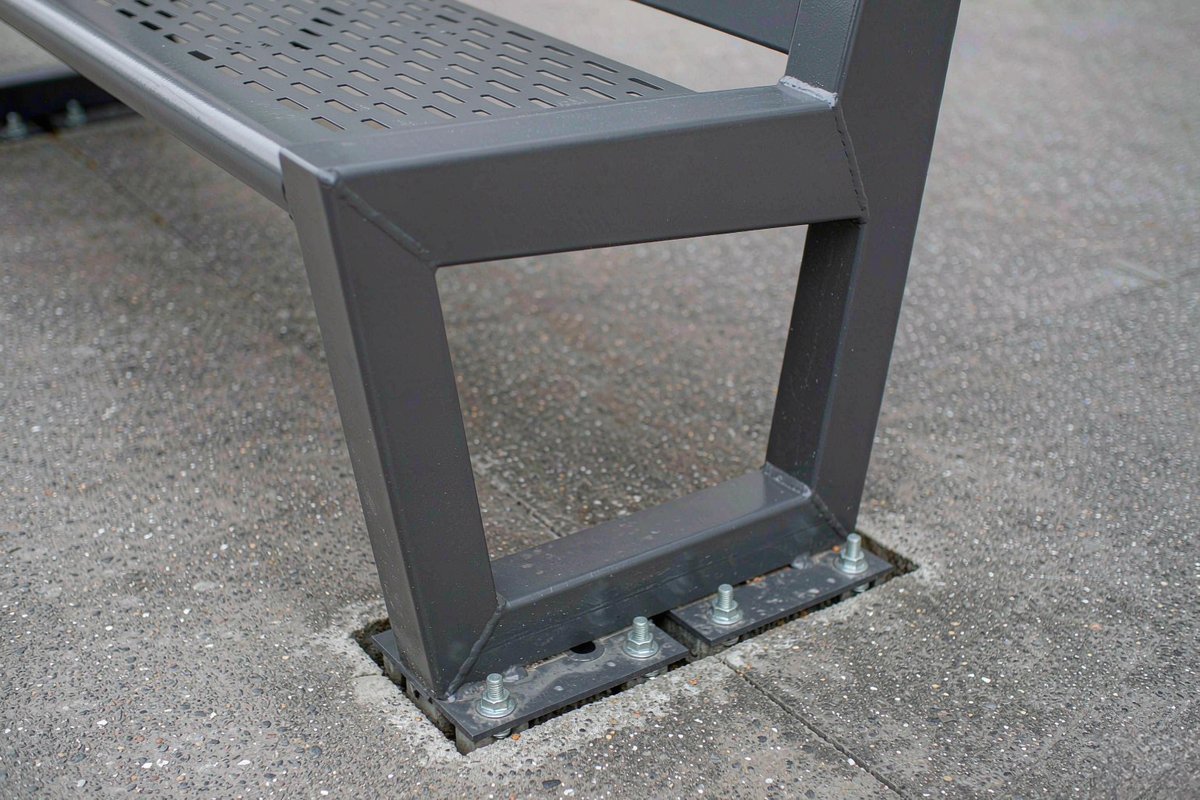
Drain holes and stand-offs. Bin bodies need drain holes at the base, and any closed profile should either be sealed or drained. Legs and base plates are best detailed so the coating is not sitting in a permanent puddle — a small gap or polymer foot does the job.
Fixings. The fastener should be at least as corrosion-resistant as the part it holds. Stainless or galvanized bolts on a painted frame, with isolating washers where two metals meet, prevent both rust streaks and galvanic attack. On park benches and picnic tables, fixings are also the first thing a maintenance crew replaces, so standardising them pays off for years.
Welds and edges. Weld seams should be continuous where water can enter, and powder coats build up thin on sharp edges — rounding edges before coating keeps film thickness where it is needed.
The ground-level zone. The bottom 50 mm of any outdoor product sees standing water, splash, salt and lawn equipment. This is where galvanizing or stainless earns its cost, and where a purely decorative finish fails first.
What does a maintenance routine that actually stops rust look like?
Even the best specification needs eyes on it. A routine that works for most public sites:
Twice a year — inspect. Before winter and after spring thaw, walk the site and look at the risk points: welds, edges, fixing points, chips in the coating, and the ground-level band. Coastal and de-icing-salt sites should move to quarterly.
Immediately — touch up. A coating chip the size of a coin is a five-minute repair with a matching touch-up kit; left alone, it becomes a rust bloom that spreads under the film and eventually means panel replacement. This is the single highest-value habit in the whole routine.
Seasonally — wash. Dirt holds moisture against the coating, and salt residue keeps working after the rain has gone. A wash with mild detergent and a rinse, especially at the base of ash columns and bins that collect residues, keeps both stainless and coated surfaces sound. On stainless parts, wash along the grain and dry — and never use a carbon-steel brush, which is how deposit rust starts.
Annually — check the wood-metal interface. Where timber slats meet steel frames on benches, trapped moisture is common; re-tightening fixings and confirming the drainage gap keeps both materials healthy. For the timber side of that job, see our Merbau slat maintenance guide.
Where does rust usually start first — and what should you check each season?
If you only have ten minutes per visit, check in this order: fixings and washers, horizontal ledges and louvres where water sits, weld seams at joints, coating chips on edges, and the base band where the furniture meets the ground. Rust caught at any of these stages is a touch-up job; rust caught after it has crept under the coating is a replacement.
None of this is complicated, but it is deliberate — and it is decided at the specification stage long before the first inspection round. If you are comparing suppliers, ask specifically about pretreatment, coating thickness at edges, fastener materials and drain detailing; those four answers predict how the furniture will look in year five far better than a finish sample. Our project references show the same steel families performing across coastal, mountain and plaza environments, and we are happy to walk through the specification line by line.
Frequently asked questions
- Why is my stainless steel outdoor bin showing rust stains?
- Surface discolouration on stainless steel is usually deposit rust, not the base metal corroding: iron particles from nearby grinding, carbon-steel tools or fasteners sit on the surface and stain. Washing with a mild cleaner, rinsing and drying, plus replacing any carbon-steel contact points, normally removes it.
- Does powder coating stop rust completely?
- No — powder coating is a barrier, not a cure. It performs well while intact, but chips at edges and around fixings expose bare steel where rust starts. Quality comes from pretreatment and coating thickness at the factory, plus prompt touch-up of scratches on site.
- How often should outdoor steel furniture be inspected?
- Twice a year is a sensible baseline for most sites — before winter and after spring thaw — focusing on welds, fixing points, edges and the ground-level zone where water collects. Coastal promenades and sites that use de-icing salt deserve quarterly checks.
Specifying steel furniture for a demanding site? Tell us the environment — coastal, road-side or inland plaza — and we will propose the finish and detailing to match.
Get a quote