
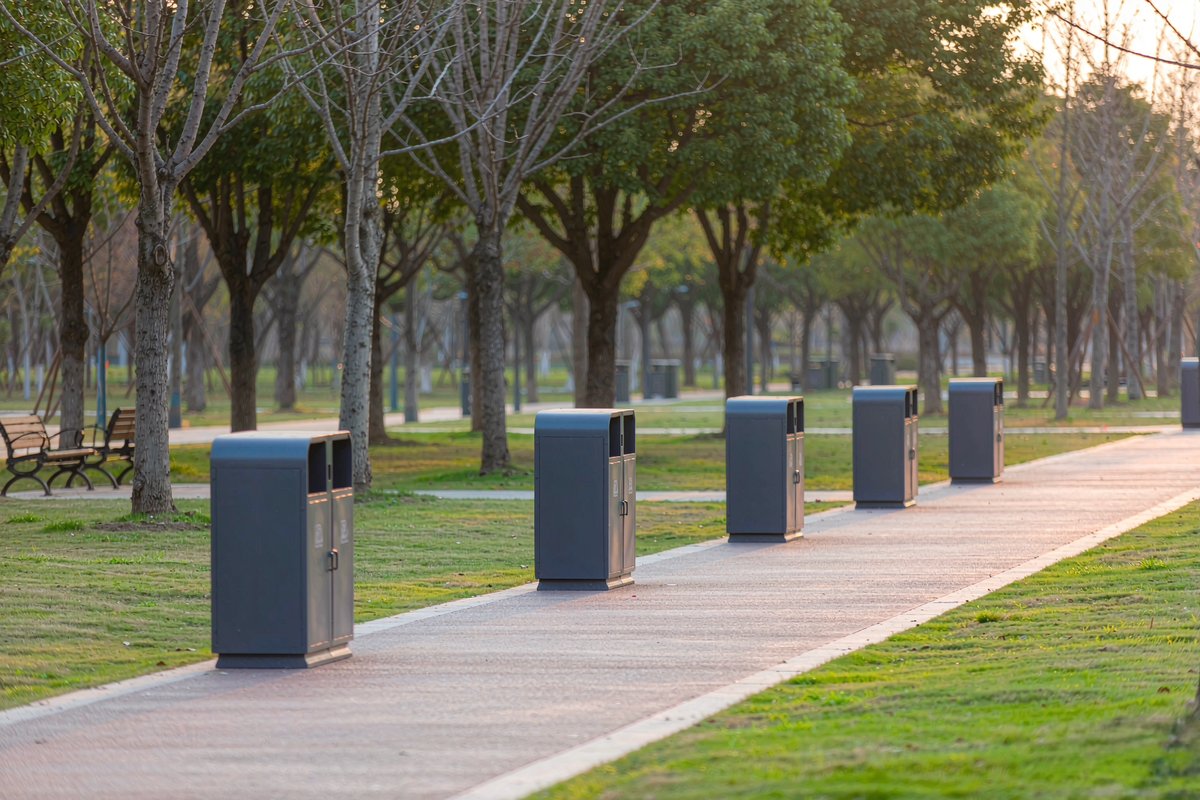
At a glance
- Count from behaviour, not area: entrances, gathering spots and trail nodes generate most litter — not square metres.
- Use walk time as the coverage test: 1–2 minutes in busy zones, up to about 5 minutes on quiet trails.
- Match the station to the streams: single or twin bins on paths, 3–4 stream stations where food and recyclables appear.
- Check emptying capacity last: a bin that overflows by mid-afternoon trains visitors to drop litter beside it.
What actually decides how many litter bins a park needs?
Ask five park managers and you will get five different bin counts for the same sized site. The difference is almost never the area — it is what visitors do there. Litter volume tracks a handful of behavioural factors: how long people stay, whether they eat, whether the zone is exposed to wind, and how many decision points (entrances, junctions, exits) a visitor crosses.
A 10-hectare park used mainly as a walking through-route needs far fewer bins than a 4-hectare park with a playground, picnic lawn and food kiosks. That is why bin schedules built purely from area-per-bin formulas tend to over-provide on quiet lawns and under-provide at the gate. Before any arithmetic, map the park's behaviour: where do people enter, where do they stop, and what do they carry in?
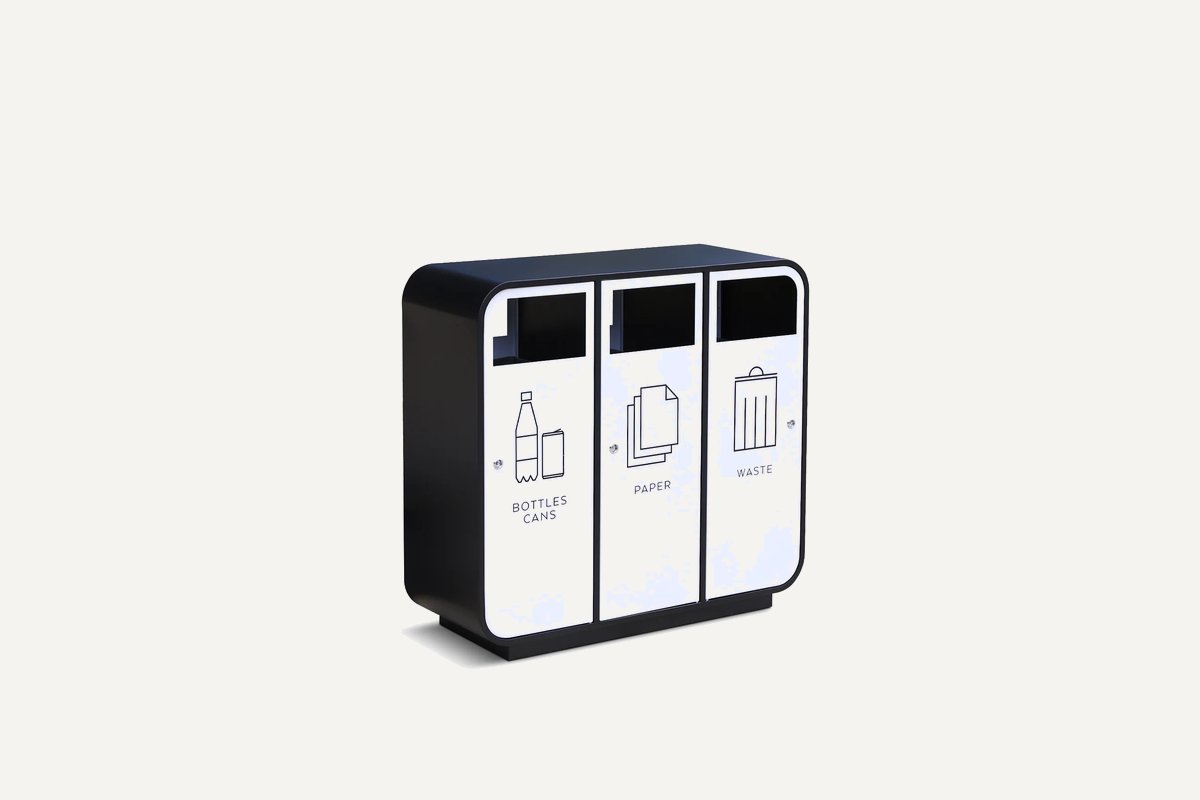
The waste streams you plan to collect also change the count. If the park runs source separation, each position becomes a station of two to four outdoor litter bins instead of one — which is why stream decisions and bin counts should be made together, not in sequence.
How do you turn visitor numbers into a bin count?
Here is the method we suggest when a park team asks us to size a bin network from scratch. It takes a site plan and one afternoon.
Step 1 — Estimate peak-hour visitors. If you only know daily attendance, a common approximation is daily visitors divided by ten, adjusted upward for event days. Landscape architects and park operators usually hold this figure already.
Step 2 — Divide by a per-bin load. As a starting point, many park teams plan one bin position per 30–40 peak-hour visitors in mixed-use parks. Busy food areas need tighter ratios; quiet walking loops can run looser. Treat the result as a baseline, not a target.
Step 3 — Test walk-time coverage. Draw a 1–2 minute walking radius (roughly 100–150 m on a path) around every proposed position. Every busy point — entrances, playground exits, picnic clusters, viewpoints — should fall inside a radius. Add positions where the map shows gaps; delete positions where two overlap.
Step 4 — Convert positions into stations. A position at a path node becomes a single or twin bin. A position at an entrance or food area becomes a 3–4 stream sorting station.
Step 5 — Sanity-check against emptying. Estimate each station's fill time against your cleaning rounds. If the busiest station cannot survive until the next round, either upsize the liner or add a round — overflowing bins undo everything else.
Where should each bin go inside the park?
Once the count is settled, placement decides whether the network actually gets used. Bins belong at the points where hands are already full or where people naturally pause: the exit side of playgrounds and picnic areas, bench clusters (pair them with park benches so seating and disposal land in the same stop), trail junctions, and the last few metres before exits, where people finish food and drinks on the way out.
Two placement details are easy to miss. First, visibility: a bin hidden behind a hedge or planter might as well not exist — site it where the next user can see it from a distance. Second, service access: every position needs a clear pulling route for the emptying trolley, or the round will be skipped and the bin will overflow.
In dog-walking areas, a dedicated dog waste bin at the gate typically outperforms adding capacity to the general bins, because the waste stream and the emptying schedule are different.
Single bins or sorting stations: which configuration fits each zone?
The count tells you how many positions you need; the configuration tells you what stands at each one. The table below is the rule of thumb we use when advising on park layouts.
| Zone | Rule of thumb | What to specify |
|---|---|---|
| Entrances and transit stops | One station per entrance, sized to peak flow | 3–4 stream sorting station, anchored and labelled |
| Lawns, playgrounds and picnic areas | One position within sight of every gathering spot | Twin bins near picnic tables; separate dog waste bin at park gates |
| Walking loops and trails | One position every 4–5 minutes of walking | Single litter bin at junctions and rest points |
| Food kiosks and event lawns | Double the baseline ratio; expect organics | 4-bin station plus a spare liner kept on site |
Which mistakes most often undermine a calculated bin plan?
Even well-sized networks fail in three predictable ways. Over-providing at entrances only: teams concentrate bins at the gate because that is where complaints arrive, leaving the middle of the park uncovered — litter then appears along the paths instead. Ignoring the emptying round: a count that looks right on the plan can still fail if one station fills twice per round; capacity and frequency must be checked together. Inconsistent labelling: if adjacent parks or zones use different colours for the same stream, visitors stop sorting altogether — the specification of each bin should include its graphics, not just its body.
Finally, treat the plan as a living document. Usage patterns shift with seasons and new attractions, so re-walk the coverage test after the first quarter and move or add positions where litter actually accumulates.
Frequently asked questions
- How many litter bins does a small park need?
- Start from behaviour, not area. A small neighbourhood park usually works with one multi-stream station at the entrance, one twin bin at the central gathering spot and single bins at each secondary exit — then check walk-time coverage and emptying rounds, and add or remove positions from there.
- How far apart should litter bins be placed in a park?
- In busy zones such as entrances, plazas and picnic areas, keep every point within a 1–2 minute walk of a bin. On quieter walking loops, spacing of around five minutes of walking between bins is usually acceptable, as long as bins sit at trail junctions and rest points rather than at arbitrary intervals.
- Should a park use single litter bins or sorting stations?
- Use both, matched to the zone. Single or twin litter bins suit paths and trail nodes where waste is mostly general litter, while 3–4 stream sorting stations belong at entrances, food areas and other spots where recyclables and organics appear in volume. Consistent colour coding and icon labels matter more than the exact stream count.
Planning a bin network for a park or public realm project? Send us the site plan and peak-hour estimates — we will return a position-by-position configuration proposal.
Get a quote