
At a glance
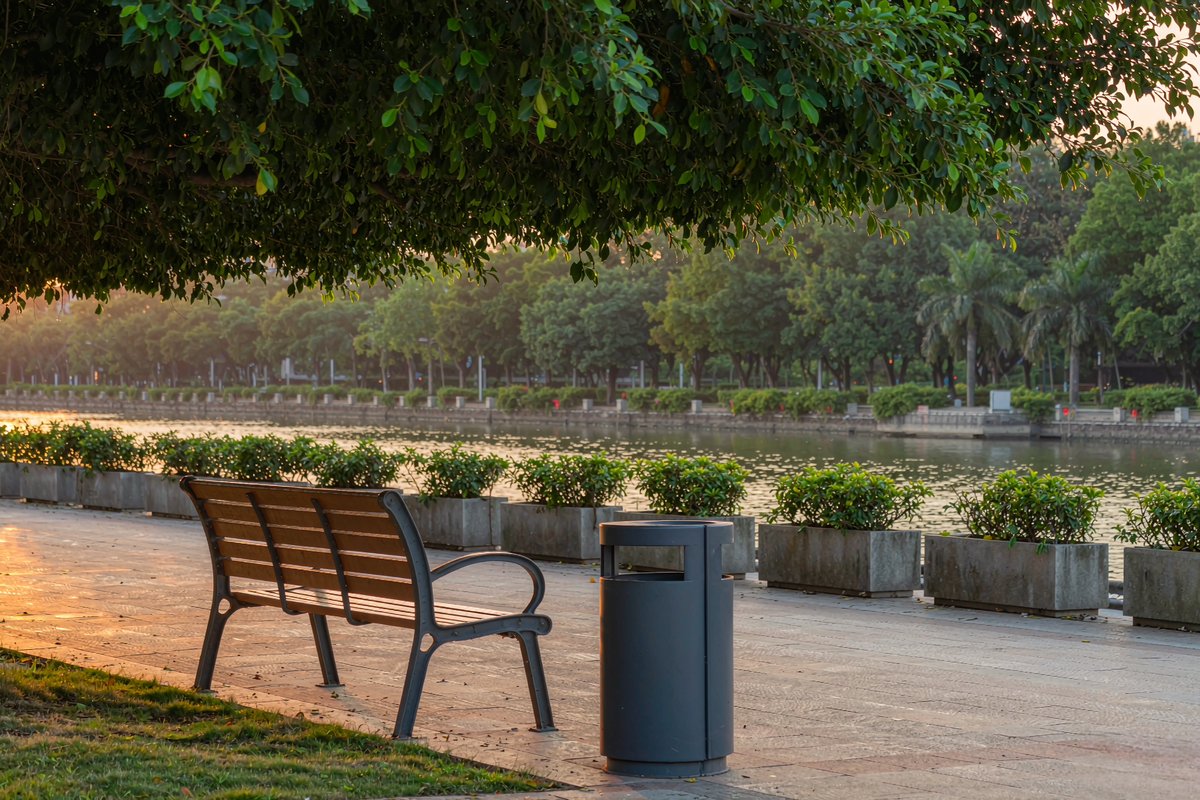
- Cluster benches at natural pause points every 200–300 m, facing the water where the view allows.
- Place litter bins at nodes and junctions instead of dotting them evenly along the whole route.
- Use planters to protect the water's edge and separate walkers from cyclists at conflict points.
- Specify corrosion-resistant finishes — riverside humidity and splash zones punish thin coatings fast.
How do you zone a greenway so people actually stop and stay?
Walk any popular waterfront path and the pattern repeats: people stop where something changes — a viewpoint opens, a pier starts, a playground or food kiosk appears, the path meets a street. Those are the nodes, and that is where furniture belongs. A bench placed mid-segment between two attractions will sit empty while the viewpoint 80 metres on is crowded; a bin on an empty stretch collects little, while the picnic lawn 200 metres away overflows. Start by marking the pause points on a plan, then put a bench cluster and a bin at each one.
Two practical refinements follow. First, treat rest distance as a maximum, not an average: elderly walkers and families with children judge a route by how soon the next seat appears, so on long uninterrupted segments a bench every 200 to 300 metres keeps the route usable for them even when nobody "needs" to stop. Second, orient benches towards the water — the view is the attraction, and a seat facing a hedge gets used as a rack for bags instead of as a seat.
Which materials survive best beside open water?
Riversides combine the three things that age outdoor furniture fastest: humidity, wind-blown rain and long sun hours. For frames, hot-dip galvanized steel with a quality powder coat is the workhorse; 304 stainless steel earns its premium near splash zones, at piers and around fountains. Slatted seats in dense hardwood stay comfortable in full sun but need their oiling cycle kept up in humid air — the same routine described in our guide to maintaining Merbau slats in humid climates. Whatever the frame, insist on drainage: open slat gaps, raised feet and bolted — not welded-only — fixings, so water runs off instead of pooling. The finish details that decide lifespan are covered in our article on preventing rust on outdoor steel furniture.
Benches, bins, planters: what goes where along the route
Once the nodes are marked, each element gets a simple siting rule and a short spec list.
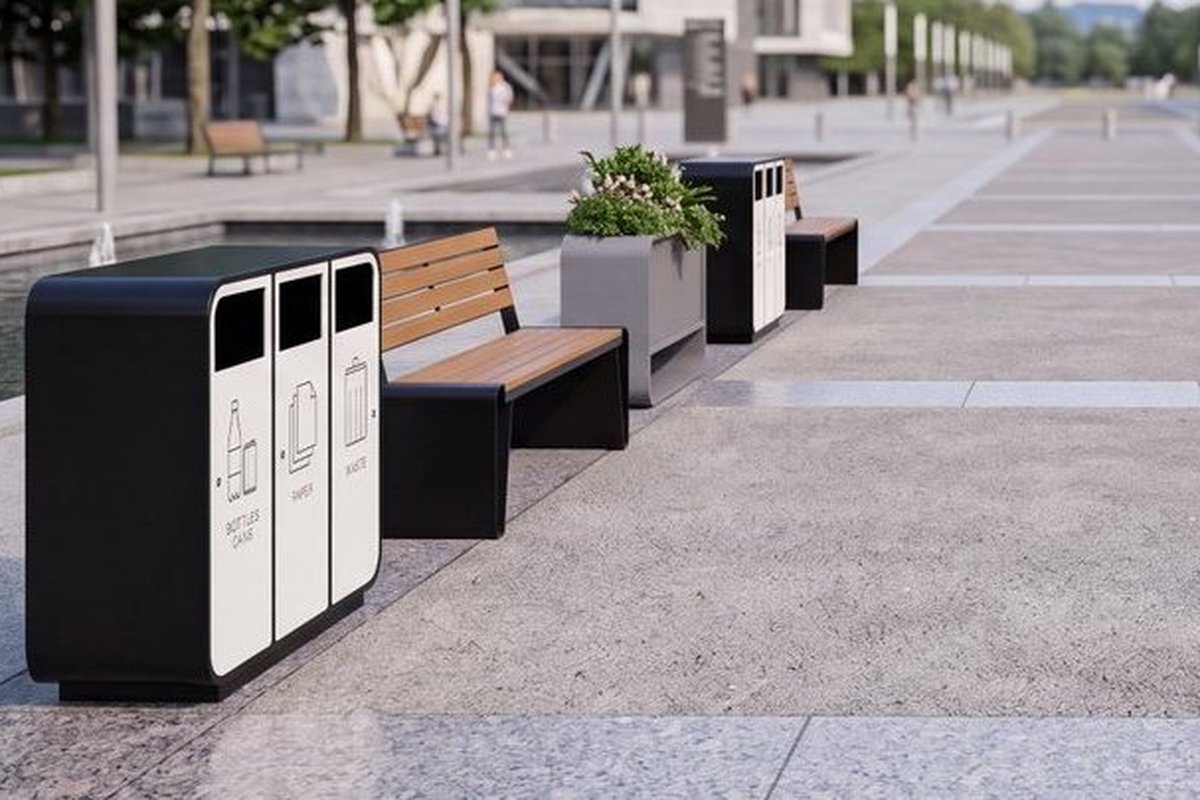
| Element | Where it goes | What to specify |
|---|---|---|
| Benches | At every node; max 200–300 m gaps between rest points, facing the water | Hardwood or composite slats, backrest and armrests, bolted anti-tamper fixings |
| Litter bins | At nodes, gates and exits — beside every bench cluster, not between clusters | Galvanized or stainless body, removable liner, hooded opening against rain and wind |
| Planters | Water's edge, path splits and road crossings where users conflict | 700–1,000 mm high, deep soil volume for shrubs, raised base and drainage holes |
How far apart should bins and benches go along the route?
For bins, resist the instinct to make the route "fair" with even spacing. Waste follows behaviour: it is created at entrances, kiosks, picnic lawns and playgrounds, and it is carried for a minute at most. A useful test is to walk the route at busy-hour pace and place a bin wherever someone carrying rubbish would pass more than a couple of minutes without one — our calculation method for park bin counts walks through the same logic with numbers. Benches follow the node plan from the section above; where a long segment has no attraction, a single mid-segment seat matters more for the route's walkability than three evenly spaced ones.
Planters are the exception to the node logic — they work as lines, not points. Where the greenway runs against a road or a cycle path, the sizing rules from our planter sizing guide apply directly: tall enough to read as a boundary, gaps kept below a body width, and heavier footprints at the corners vehicles might cut.
Bringing it together on site
The cheapest mistakes on a greenway are visual, not structural: three bench styles bought in three phases, bins that match nothing, planters in a different grey. Pick one furniture family — shared frame colours, one slat material, one bin shape — and phase the route with it. Pilot one segment first, watch a weekend of behaviour, adjust the node plan, then roll the same specification along the river. Our projects page shows the furniture families we manufacture for exactly this kind of phased public-realm work, and if you are planning a waterfront route, send us the site plan — we will return a furniture schedule sized to your node layout.
Frequently asked questions
- How far apart should benches be on a greenway?
- A common planning practice is to place benches every 200-300 m along the main route, but the better rule is to cluster seating at natural pause points - viewpoints, gates, piers and picnic lawns - and treat the interval as a maximum. Elderly walkers and families judge a route by how soon the next seat appears, not by the average spacing.
- What litter bins work best near water?
- Bins beside open water need a hooded or narrow opening so wind and rain stay out, a removable liner so crews can lift waste out without dragging the bin, and a corrosion-resistant steel or stainless body. Place them at nodes and junctions rather than evenly along the path, and always pair one with a bench cluster.
- Do planters really keep cyclists off a riverside walking path?
- They help at specific conflict points. A continuous line of 700-1,000 mm high planters reads as a boundary and physically discourages cutting through, especially where the waterside path meets a road or a cycle route. Long stretches are unnecessary - target the crossings and junctions where cyclists and pedestrians actually meet.
Planning a waterfront route? Send us the site plan, expected usage and finish requirements.
Get a quote