
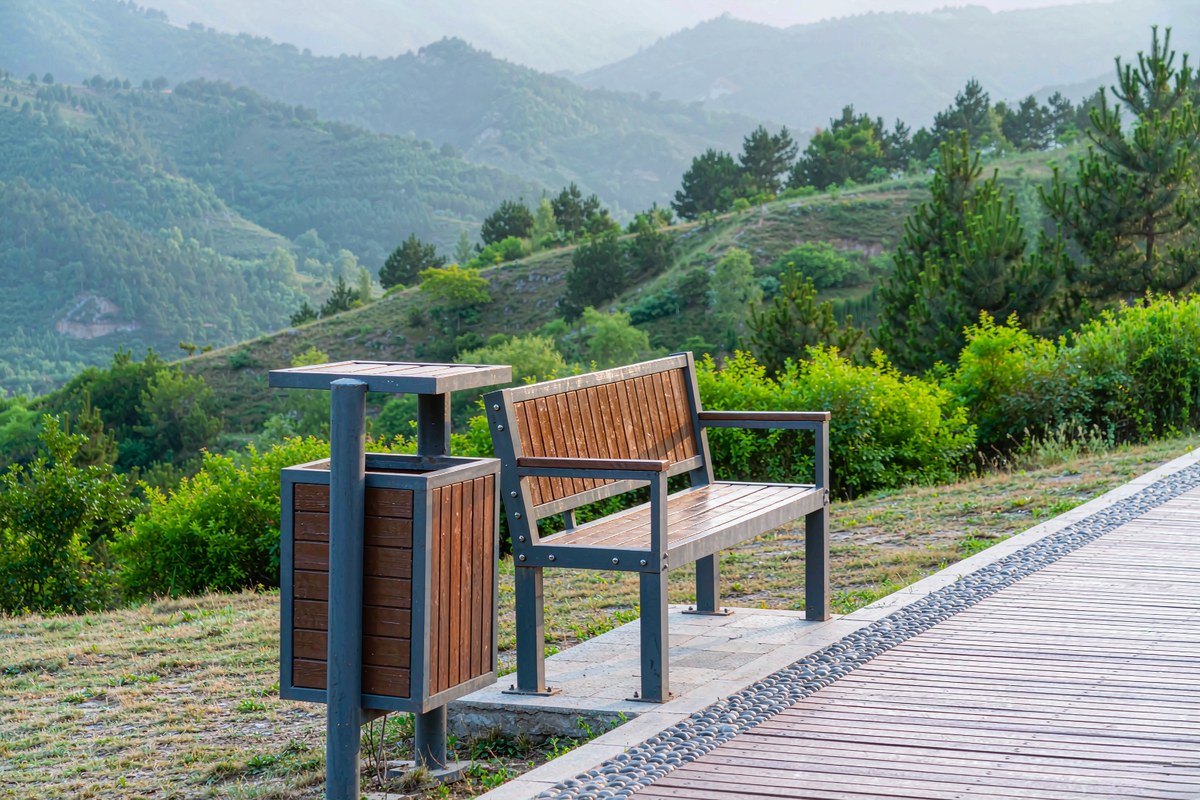
At a glance
- Wind first: hooded or covered bin openings prevent wind-blown litter, the most common complaint on exposed trails.
- UV and moisture swings favour powder-coated galvanised steel and hardwood or HDPE slats over thin painted steel.
- Site at nodes: bin and bench pairs at entrances, viewpoints and rest stops, not at fixed intervals along the trail.
- Fix everything down: through-bolted anchors on concrete pads; nothing freestanding on exposed ridges.
What does high altitude actually change about outdoor furniture?
Three forces work faster on a mountain than in a city park. Ultraviolet radiation intensifies with elevation, so paints fade and plastics chalk earlier than their lowland service life suggests. Moisture swings — morning condensation followed by strong afternoon sun, plus freeze–thaw in colder seasons — open up coatings and push water into every scratch. And steady or gusting wind turns any open bin top into a distribution system for lightweight waste.
Visitor behaviour changes too. People carry food and drinks up and expect to dispose of them on site, and wildlife — birds, foxes, monkeys depending on the region — learns quickly which bins are easy to raid. LVEN has supplied seating and litter bins for scenic destinations including the Jade Dragon Snow Mountain area, and the same specification logic repeats across mountain projects: fewer, better-built nodes beat many lightly-built points scattered along the trail. The projects page lists the reference sites we can discuss publicly.
Which litter bins work best on scenic trails?
The single most important feature is a covered or hooded opening. It keeps gusts from lifting wrappers out of the liner and makes the bin far harder for animals to work. Pair that with a lockable access door, a liner with lifting handles for a fast emptying round, and a body in galvanised or stainless steel that can be hosed down. Wood-look slats on the sides help a bin blend into a natural setting, which matters in protected landscapes where bright plastic bins read as visual pollution.
Capacity is a balance rather than a maximum. Oversized liners encourage long intervals between emptying, and a half-week of trail waste in one exposed liner is exactly what wind and wildlife exploit. Two medium bins per node usually beat one large one — and pairing a litter side with a recycling side at the entrance node matches how most scenic areas now manage streams. For comparison, coastal sites share the corrosion challenge but not the wind-and-wildlife one; see how to choose outdoor litter bins for a coastal park for the salt-air version of the problem.
Where should bins and benches sit along a mountain route?
Follow the natural stops. A trailhead sorting station handles the largest volume and sets the tone for the route. After that, place a bin and bench pair wherever visitors already pause — viewpoints, seat-height stair runs, shelters, junctions — rather than measuring fixed intervals. As a planning rule, a rest node every 20–30 minutes of walking covers most abilities on a mountain path; bench spacing on walkable routes follows the same walk-time logic.
At viewpoints, choose park benches with backrests and armrests: less sure-footed visitors use the armrests to sit and stand, and a backrest invites the longer stay that makes a viewpoint worth the climb. Keep bins slightly off the view line — beside the path on the approach, not framed against the panorama — and never site a bin or bench on fragile vegetation where desire lines will widen into erosion gullies.
Which materials survive mountain conditions?
| Material | Strengths | Watch-outs |
|---|---|---|
| 304 stainless steel | Corrosion-free, easy to wash down, strong look at entrances | Shows scratches; higher cost than coated steel |
| Galvanised steel + outdoor powder coating | Cost-effective, colour-matchable, handles UV well | Recoat deep scratches before rust blooms |
| Hardwood slats (merbau, teak) on steel frames | Natural appearance, warm touch, replaceable slats | Needs periodic oiling to hold colour |
| HDPE / recycled composite slats | Will not rot or splinter, minimal upkeep | Dark colours heat up in strong high-altitude sun |
How do you keep maintenance realistic in remote sites?
Remote sites rarely get daily attention, so design for repairs by non-specialists. Modular slats let a caretaker swap one damaged slat with basic hand tools instead of replacing a bench; the procedure is the same one described in Merbau bench slat maintenance. Lockable access doors, spare-part kits delivered with the first order, and finishes that can be touched up locally keep the fleet serviceable between visits.
Plan the emptying round as carefully as the siting: small vehicles or carrying frames need a workable path between nodes, and liners should be sized to what a two-person team can move safely. If you are specifying a full route — bins, benches, fixings and the emptying plan — send the trail layout to our contact page and we will return a node-by-node proposal with quantities and finishes.
Frequently asked questions
- What is the best litter bin material for mountain parks?
- Galvanised steel with an outdoor powder coating is the dependable default; 304 stainless steel suits high-visibility entrances and sites with heavy salt or de-icing use. Hardwood slats soften the look at scenic and heritage sites while the steel structure carries the durability.
- How do you stop animals and wind from scattering bin waste?
- Use bins with hooded or covered openings and self-closing flaps, keep access doors lockable, and empty on a fixed round so liners are never left overfull. Open-top bins fail first on exposed ridges and viewpoints.
- How far apart should trail bins and benches be?
- Concentrate them at nodes instead of spacing evenly: a large sorting station at the trailhead, then a bin and bench pair at each rest stop and viewpoint — roughly every 20–30 minutes of walking on mountain routes.
Need this specified for your own site? Send us the scene, quantity and finish requirements.
Get a quote