
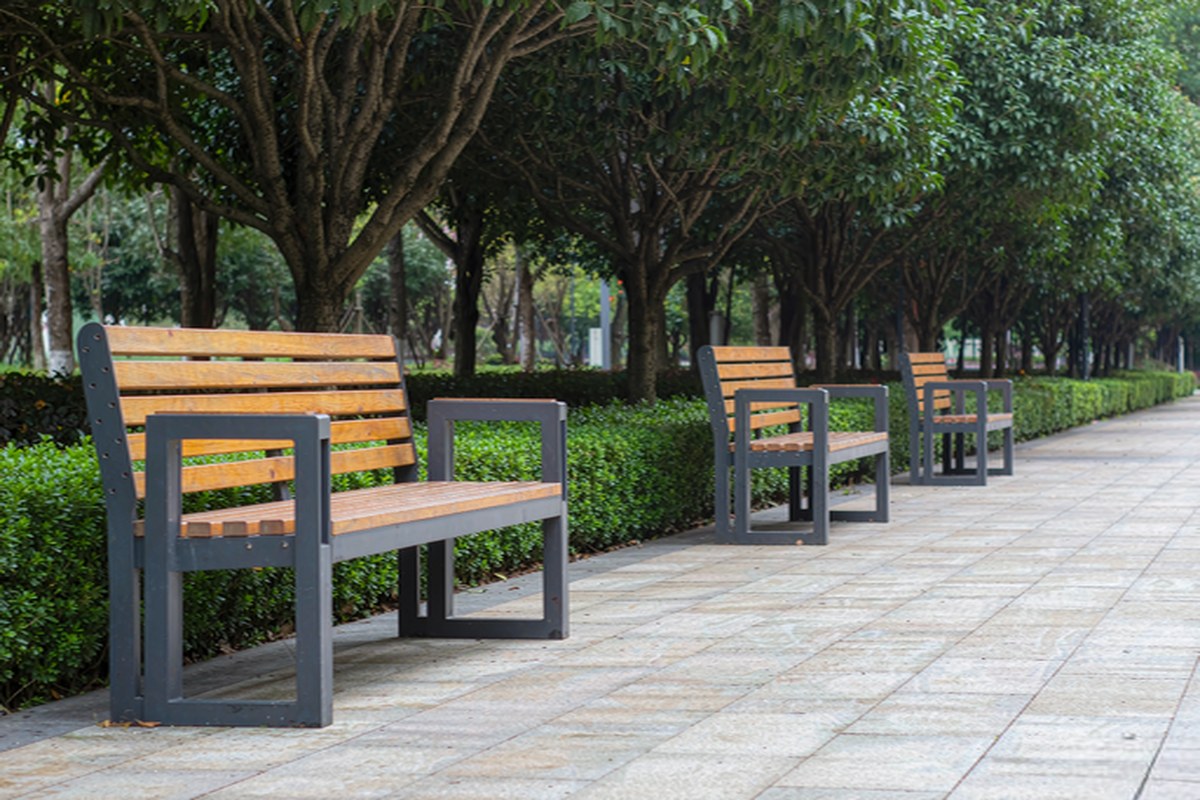
At a glance
- A backrest changes posture and dwell time, not the seat height you should be specifying.
- Within one frame family the backrest version stands 76 to 83 cm overall and is about 5 cm deeper.
- Backless benches suit short stays, narrow footways, snow shedding and fast cleaning underneath.
- Specify both from one family so a scheme reads as one design, not two purchases.
What actually changes when a bench has a backrest?
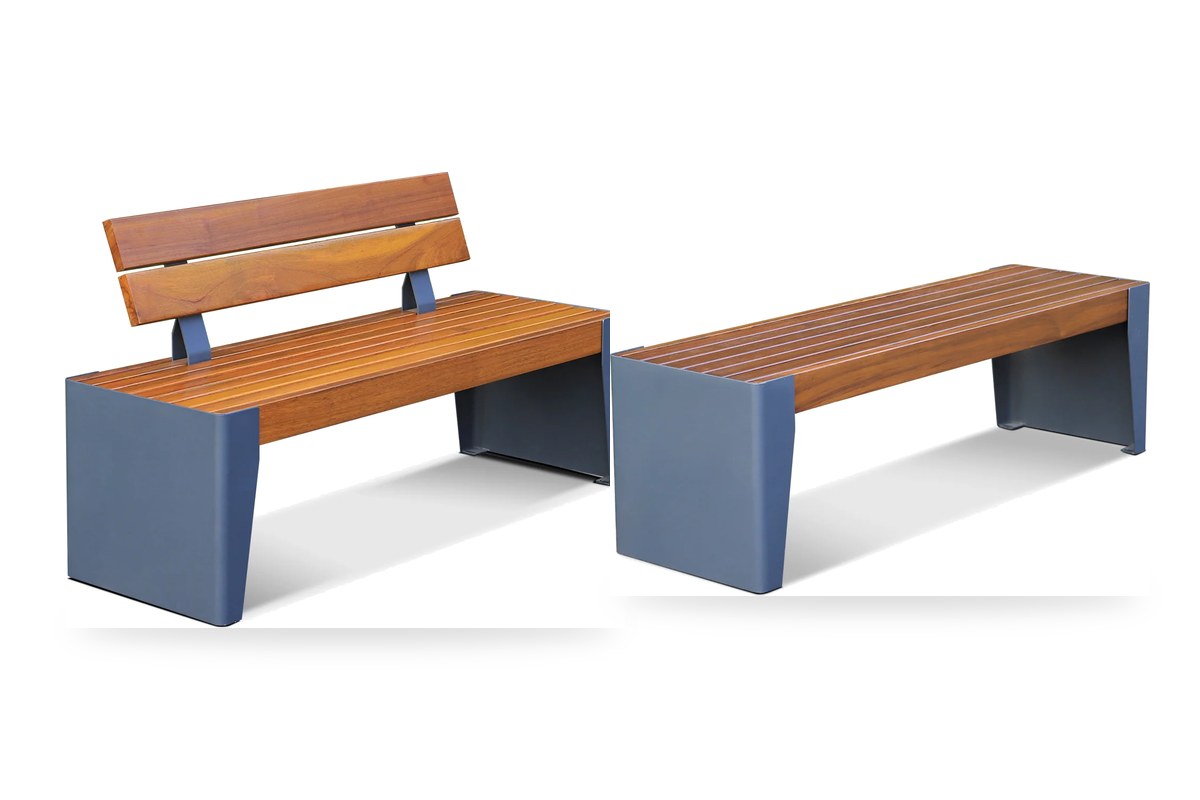
Structurally, a backrest is a second plane of slats carried on uprights that tie into the same end frames. On many ranges the seat frame, the slat profile and the finish are shared between the two versions, which is why the same bench appears with and without a back. The OTY-42 and the OTD-42 show the pattern clearly: both are offered at 150 cm and 180 cm long, both are built from galvanised or stainless steel with timber-look slats, but the backrest version stands 78 cm overall and 50 cm deep, while the backless version is 45 cm high and 45 cm deep. Those 33 cm of height and 5 cm of depth are the entire physical difference.
What the extra height buys is posture. A backrest supports the lumbar area and gives older visitors something to lean and push against when standing up, so the bench holds people for longer. A backless bench is a perch: it invites a short pause, and it keeps sightlines over the seat clear because there is nothing at head height behind it.
Which locations suit each type?
The decision turns on how long someone stays, and what has to stay visible over the seat.
| Location | Better default | Why |
|---|---|---|
| Viewpoints, lakeside edges, promenade overlooks | Backrest | People stop for ten minutes or more and want to face the view without holding themselves upright. |
| Transit stops, station forecourts, clinic and campus waiting edges | Backrest | Waiting is the whole activity; a backrest and armrests help visitors stand up again. |
| Playground perimeters | Backless | Adults perch briefly and keep watching the equipment; nothing at eye level blocks the sightline. |
| Narrow footways and planter edges | Backless | 45 cm of depth leaves more clear width for prams and wheelchairs than a 60 to 69 cm deep backrest bench. |
How do seat height and footprint change what you specify?
The two types live in different height bands, and mixing them up is the most common specification error. Backless benches in the LVEN range finish between 42 cm and 46 cm overall, because the overall height is the seat itself: 42 cm on the OTD-19, 43 cm on the OTD-36, 45 cm on the OTD-25A and OTD-42, 46 cm on the OTD-59. Bench heights including a backrest run from 76 cm to 83 cm, with most models at 78 to 81 cm and the OTY-25A at the top of the band. Quote seat height as the working dimension and overall height as the envelope, or a backrest bench looks 30 cm too tall on the drawing.
Footprint matters just as much on tight sites. Backless benches are 42 cm to 52 cm deep; backrest benches reach 50 cm to 69 cm because the back plane leans behind the seat. On a footway that difference decides whether two people and a pram can pass at the same time, and a backrest bench also needs clear space behind it, since people step back to stand up. Length is the easier variable: 150 cm and 180 cm cover most public work, and the gap between benches is a separate calculation, covered in our guide to park bench spacing.
Which type is easier to clean, dry and repair?
Rain and snow behave differently on the two profiles. A backless bench is a single plane: water runs off, snow can be brushed clear in one pass, and there is no cavity for leaves to lodge in. A backrest bench shades its own seat, so after rain or frost it stays damp longer, and grit and leaf litter collect in the seat-to-back junction where a broom cannot reach.
Repair follows the same logic. Both types take replacement slats, as set out in our guide to replacing a park bench slat. The backrest version simply has more parts: uprights, brackets and a second run of slats, each with fasteners to check annually. Where the frame is stainless and the fasteners are not, that check matters more, as covered in 201 vs 304 stainless steel and our rust prevention guide.
How do you mix both in one scheme without it looking improvised?
Start from one frame family. Specifying the OTY-42 and the OTD-42 together, in the same slat material and frame colour, gives two behaviours in one visual language and one set of spare slats. Then assign by dwell pattern: backrest benches where people settle, backless benches at the nodes where they pause. Keep at least one backrest bench with armrests at each main entrance and on the accessible route, following our guide to designing outdoor furniture for accessibility.
Anchoring should be consistent too: both types use the same base plates within a family, so crews do not improvise a fixing at every bench. Surface plates suit paving, in-ground legs suit soft ground and exposed sites, as set out in how to anchor a park bench and anti-theft fixings. The full range sits in our park bench section.
What belongs on the checklist before ordering?
- Confirm seat height first, then check the overall height of a backrest bench against walls, hedges and handrails.
- Measure the clear width left for passing pedestrians once bench depth is added.
- Inspect the seat-to-back joint on a sample: gap size, slat alignment and access to the fixing bolts.
- Order a stock of spare slats in the same profile and colour, so a damaged bench is repaired rather than replaced.
Where a scheme needs both profiles, send us the plan and the dwell pattern and we will match lengths, slat material and fixing type across the two versions, review it against comparable installations, and quote the mix.
Frequently asked questions
- Is a bench with a backrest more comfortable than a backless bench?
- For stays longer than a few minutes, most people find the backrest version more comfortable, because it supports the lumbar area and gives them something to push against when standing up. Backless benches suit short pauses and keep sightlines open. Comfort depends more on seat height, depth and slat spacing than on the backrest alone.
- What is the standard height of a park bench with a backrest?
- Overall height across the LVEN range runs from 76 cm on the OTY-28 to 83 cm on the OTY-25A, with most models at 78 to 81 cm. The seat plane itself sits in the same working band as a backless bench, whose overall height is 42 to 46 cm. Specify the seat height first, then check the overall height against the site.
- Do backless benches need less maintenance?
- They have fewer parts and fewer joints where debris collects, so cleaning is quicker and there is no seat-to-back junction to inspect. Both types still need fixing checks and slat inspection. The difference is in cleaning time and in the number of components, not in whether maintenance is needed.
Choosing between the two profiles for a park, campus or promenade? Send us the site plan and we will propose a mix in one frame family.
Get a quote